Marketing
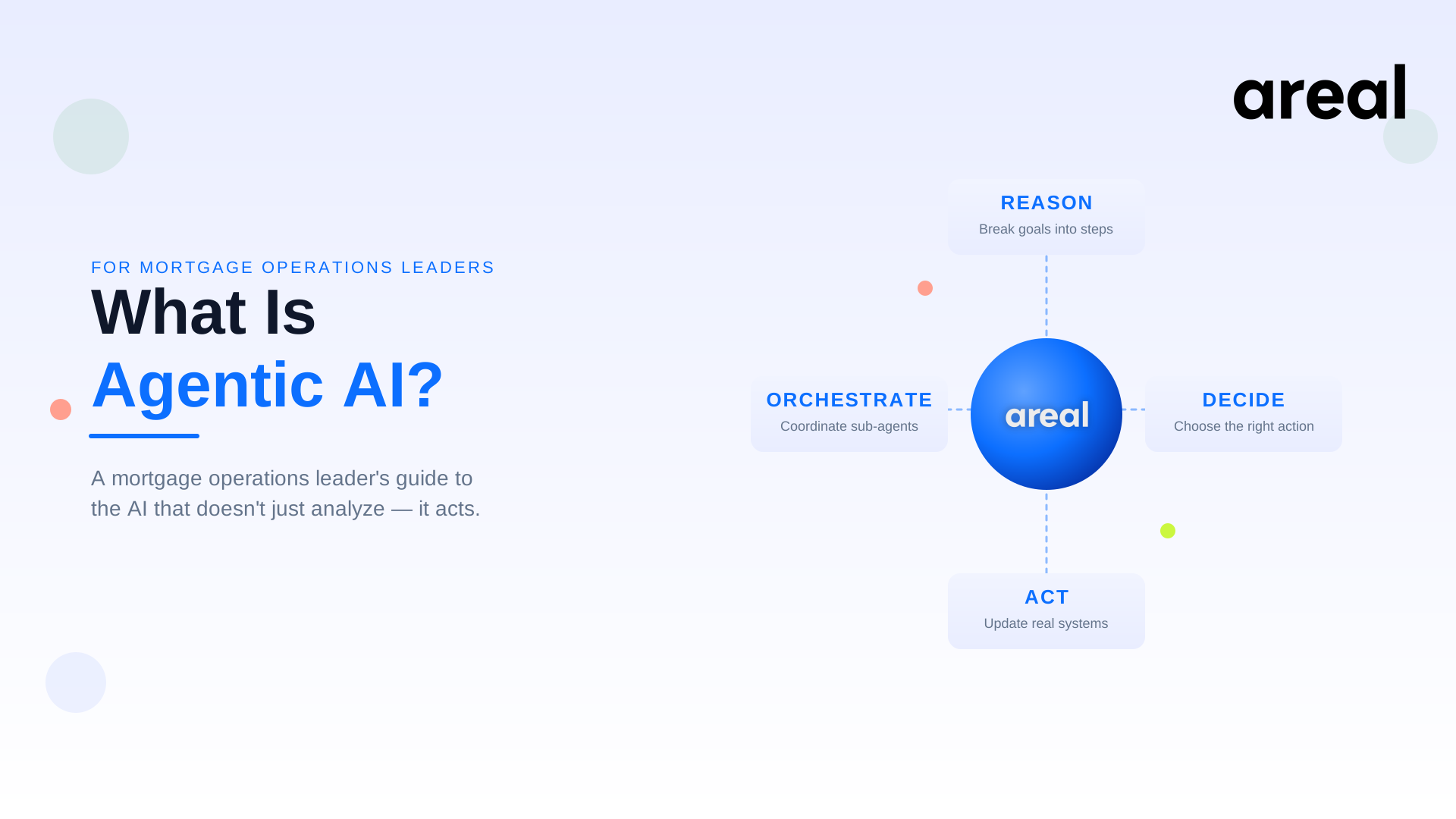
Agentic AI is software that doesn't just analyze data — it reasons about it, makes decisions, and completes multi-step workflows on its own. In mortgage operations, an agentic AI agent reads a closing disclosure, compares it to expected fees, identifies discrepancies, drafts the exception email, and updates the LOS — without a human running the playbook between each step.
The category is new enough that the term gets used loosely. Vendors call almost anything with an LLM "agentic." For mortgage operations leaders evaluating real platforms, this guide separates what the term actually means, how it differs from the AI generations that came before, and where it fits in your stack today.
Agentic AI is autonomous software that can perceive its environment, reason about a goal, choose an action, take that action, observe the result, and continue iterating until the goal is met. In a mortgage operations context, the "environment" is the LOS, the document portal, and the email inbox. The "goal" is something like "verify this funding package is ready to close." The "actions" are extracting data, comparing it against requirements, drafting emails, updating LOS fields, and routing exceptions. The "result" is a loan that funds without a human reading every page.
Three things distinguish agentic AI from earlier automation: it sets and pursues goals, it adapts when inputs vary, and it takes actions in real systems rather than just producing analyses humans then act on.
Mortgage operations has gone through three distinct generations of automation. Most lenders today have systems from all three running side by side, and the terms get conflated constantly. Here's how to tell them apart:
The first wave. Software bots that automate repetitive, rule-based tasks like data entry, form completion, and routine compliance checks. Strength: cheap, reliable, and well-suited to predictable workflows where every input looks like every other input. Weakness: breaks the moment inputs deviate from the expected pattern. Useful in mortgage for routine LOS updates and notifications, but not for anything that requires reading a document or making a judgment.
Foundational technology that converts scanned text into machine-readable data. Generic OCR caps around 50-60% accuracy on real mortgage documents because of formatting variation, handwriting, smudges, and unconventional layouts. Modern mortgage automation moves beyond raw OCR.
The second wave. Specialized machine learning trained on a specific document domain — in this case, mortgage. Handles layout variation, classifies document types automatically, extracts structured fields, and reaches 99% accuracy on critical fields when trained on enough data. This is the layer that made closing and post-closing automation viable. Areal's platform was built here, processing millions of mortgage pages per week. Read the full mortgage automation guide for the broader context.
The third wave. Builds on document AI to add reasoning, decision-making, and multi-step action. An agentic system doesn't just extract a closing disclosure — it compares it to the expected fees, identifies discrepancies, drafts the exception email, and updates the LOS. The most advanced layer of mortgage automation today.
The shorthand: RPA does what you tell it. Document AI tells you what's in a document. Agentic AI tells you what to do about it — and then does it.
Not every system marketed as "agentic" actually meets the bar. Use these four capabilities as a checklist when evaluating vendors:
The system can break a goal down into steps and figure out which step to take next based on context. "Validate this funding package" gets decomposed into "check signatures, check notary stamps, check loan amounts match, flag exceptions, draft notification email." Without reasoning, you have a workflow tool, not an agent.
The system can choose between multiple valid paths based on what it observes. If a closing disclosure doesn't balance, the agent decides whether to push corrected fees back to the LOS automatically, draft an email to the title company, or escalate to a human reviewer — based on the type and severity of the discrepancy.
The system actually does things in real systems — updates the LOS, sends emails, files documents, creates tasks — rather than just producing a report. Document AI plus action-taking is what makes a workflow run end-to-end without human keystrokes between steps.
The system can coordinate across multiple sub-agents, tools, and data sources to complete complex workflows. A mortgage closing isn't one task; it's dozens. Agentic platforms handle the handoffs.
A platform missing any of these isn't agentic — it's a step on the way to agentic. That distinction matters when you're sizing a contract.
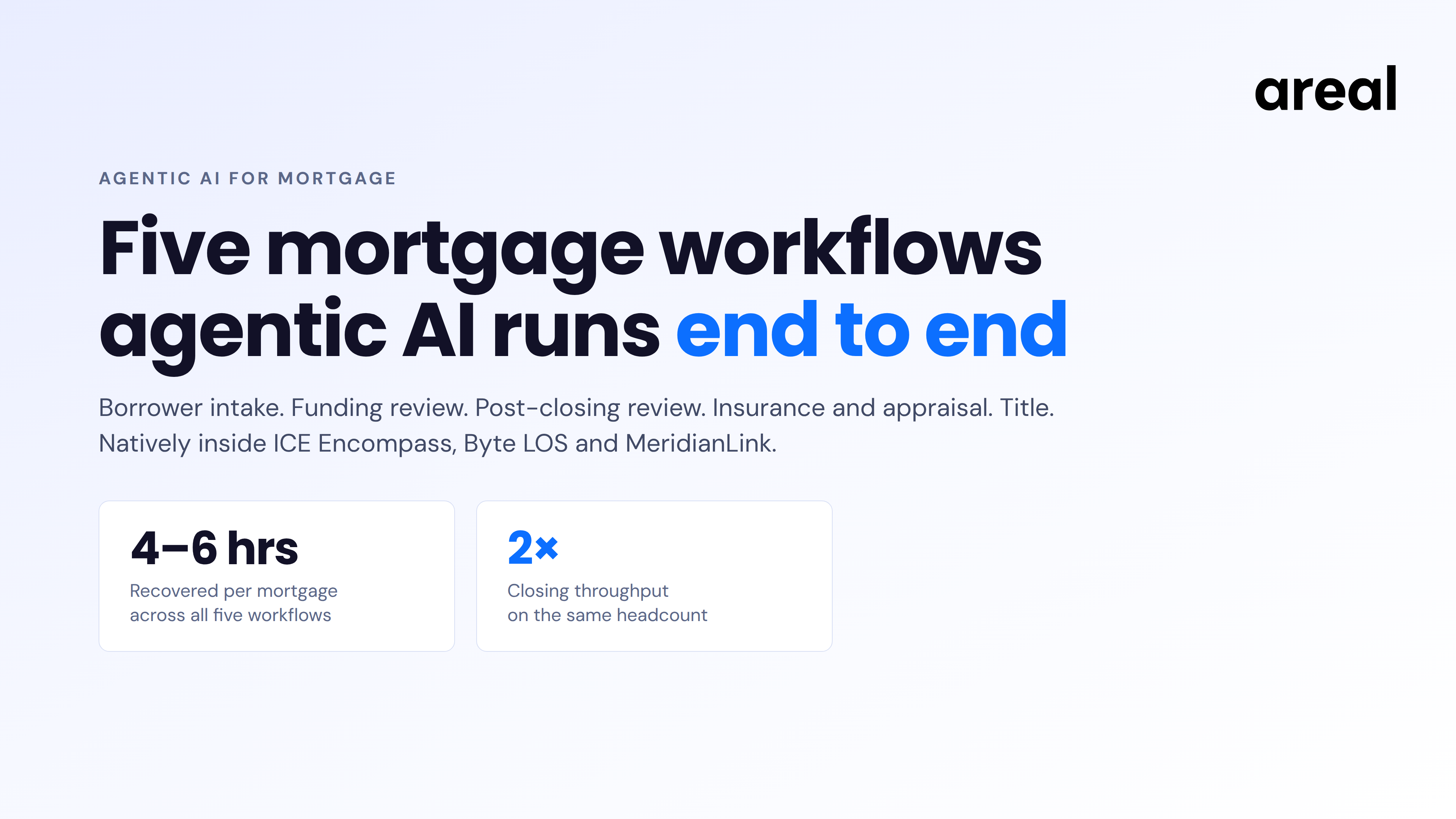
Five workflows already run end-to-end on agentic AI at top-tier lenders:
Borrower onboarding — agents classify uploaded documents across 1,500+ types, split bundled PDFs, deduplicate, extract data, and populate the LOS. Saves 1-3 hours per loan.
Funding review — agents validate signatures, notary stamps, loan amounts, and required pages, then surface flagged exceptions to the funder. Saves 20-40 minutes per loan.
Post-closing review — agents match the closing package against each investor's checklist, detect missing pages and stamps, and assemble compliant investor packages. Saves 40-80 minutes per loan and meaningfully reduces the 9.6% Freddie Mac defect rate.
Insurance and appraisal verification — parallel agents extract coverage data, validate mortgagee clause language, confirm named insureds, and flag missing comparables on appraisals. Saves 40-60 minutes total.
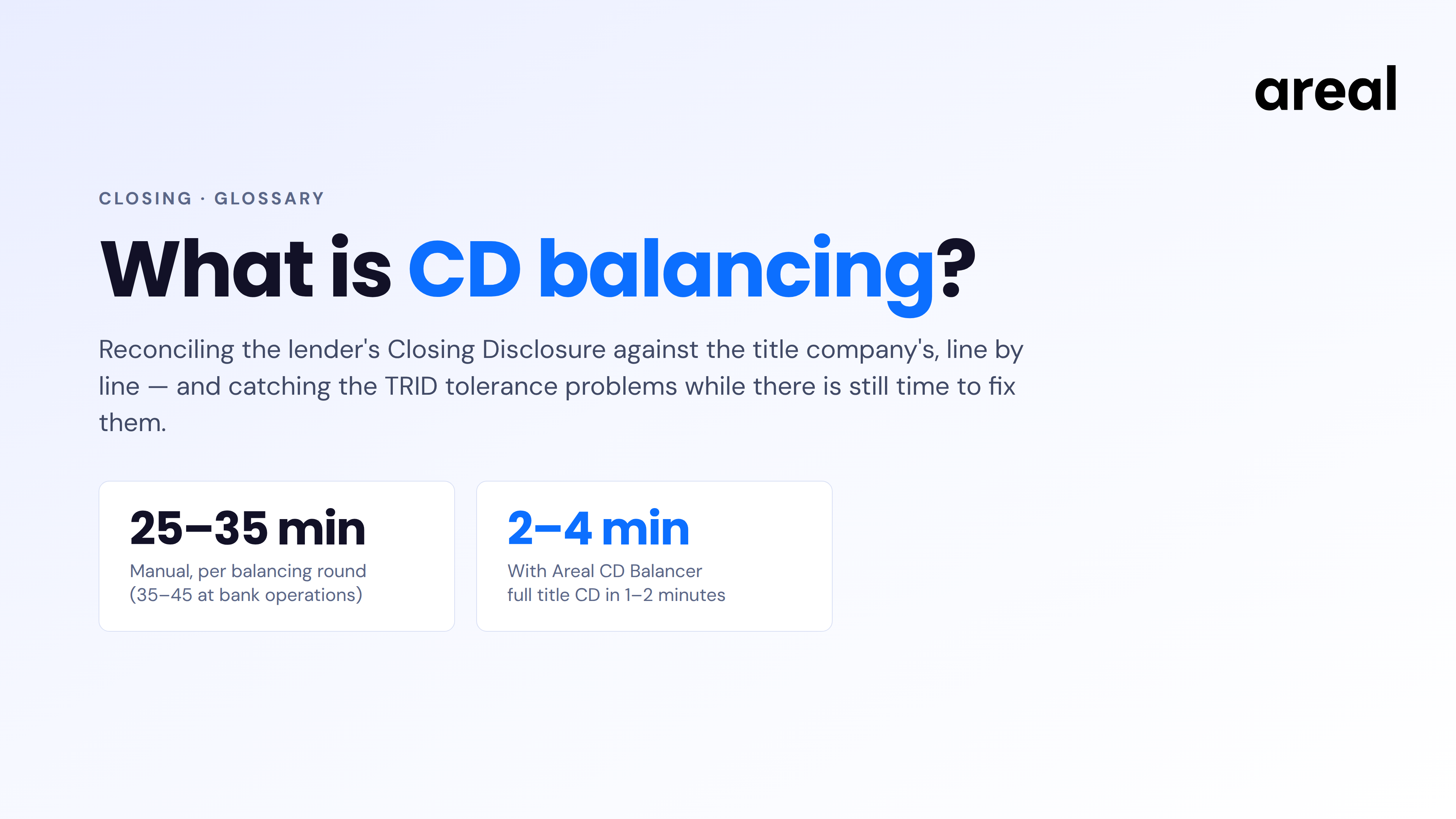
Title review and CD balancing — agents verify title commitment, settlement statement, and fee math; compare title CD to lender CD across all line items; draft exception emails to title companies; push balanced fees back to the LOS. Saves 2-3 hours per loan.
For the full breakdown of each workflow, see 5 Mortgage Workflows Agentic AI Can Run Without Human Intervention.
Nine questions to put on every RFP:
The strongest mortgage agentic AI platforms in 2026 combine deep document AI as the data foundation with an agentic execution layer on top. Generic AI bolted onto a legacy LOS workflow doesn't qualify, regardless of how it's positioned.
The trajectory is clear. Mortgage automation has moved from tools that help people work faster to systems that complete the work. Within 12-18 months, the lenders running production agentic AI for closing operations will have a structural cost advantage over those still doing page-by-page review. Defect rates will diverge. Closing throughput will diverge. Headcount math will diverge.
The lenders who win this shift will be those who invested early in platforms with deep document AI foundations and agentic execution layers — not those who waited for the category to settle. Areal launched the industry's first agentic AI platform for mortgage in October 2025. See how Copilot Agent runs full closing workflows or book a 20-minute walkthrough to see the platform on real loans.
A chatbot answers questions in a conversation. An agentic AI agent completes a goal across multiple steps and systems — reading documents, making decisions, taking actions, and updating real systems of record. Chatbots can be a UI layer on top of agentic AI, but the chatbot itself isn't agentic.
In practice, yes — both terms describe AI that can take goal-directed actions on its own. "Agentic" is the term that's caught on in enterprise software; "autonomous" is more common in robotics and self-driving systems.
Most production agentic AI systems today use a large language model as the reasoning engine because LLMs are good at decomposing goals into steps and handling natural-language inputs. But the agent itself is more than the LLM — it's the LLM plus tools, memory, decision logic, and integration with real systems. Some specialized agentic systems use smaller models or rule engines for the reasoning layer to gain speed and predictability.
Generic agentic AI hallucinates on niche document types and can't take actions in your LOS. Mortgage-specific agentic AI is purpose-trained on mortgage documents and workflows, hits 99% accuracy on critical fields like signatures and notary stamps, and integrates bidirectionally with the LOS so agents can update records, not just read them.
In the deployments we've seen, no — it redeploys them. Closers handle more loans per month with less overtime. Post-closing teams move from page-by-page review to investor relationship management and QC supervision. Hiring slows, but headcount usually stays steady while throughput doubles.
Modern mortgage agentic AI platforms are built with these regulatory frameworks in mind, include full audit trails on every action, and are typically deployed on SOC 2-compliant infrastructure. Compliance should be a buying criterion — ask vendors specifically about audit trail granularity and how their AI agents document their actions.
A pilot typically runs in 30 days, full production in 60-90 days for a single workflow, depending on LOS integration depth. Multi-workflow deployments stage over 3-6 months.
A complete agentic AI deployment across closing operations saves 5-8+ hours per loan and roughly $240-$480 per loan in operational cost. For a lender closing 10,000 loans per year, that's $2.4M-$4.8M in annual savings, with 6-10x ROI in year one.
Agentic AI is not a marketing relabel of document AI or RPA. It's a distinct architectural shift — software that reasons, decides, and acts across multi-step workflows in real systems of record. For mortgage operations, that distinction is the difference between an AI that helps people work faster and an AI that runs the work.
The category has matured. The vendors who matter have shipped real platforms running real workflows at real lenders. The question for mortgage technology buyers in 2026 is no longer whether agentic AI is real. It's which workflows to deploy first, and how fast.
Explore Areal Copilot Agent · See the 5 workflows agentic AI runs end-to-end · Book a 20-minute walkthrough
We'll show you which workflows to automate first — and the exact ROI for your volume.
Book a Demo →