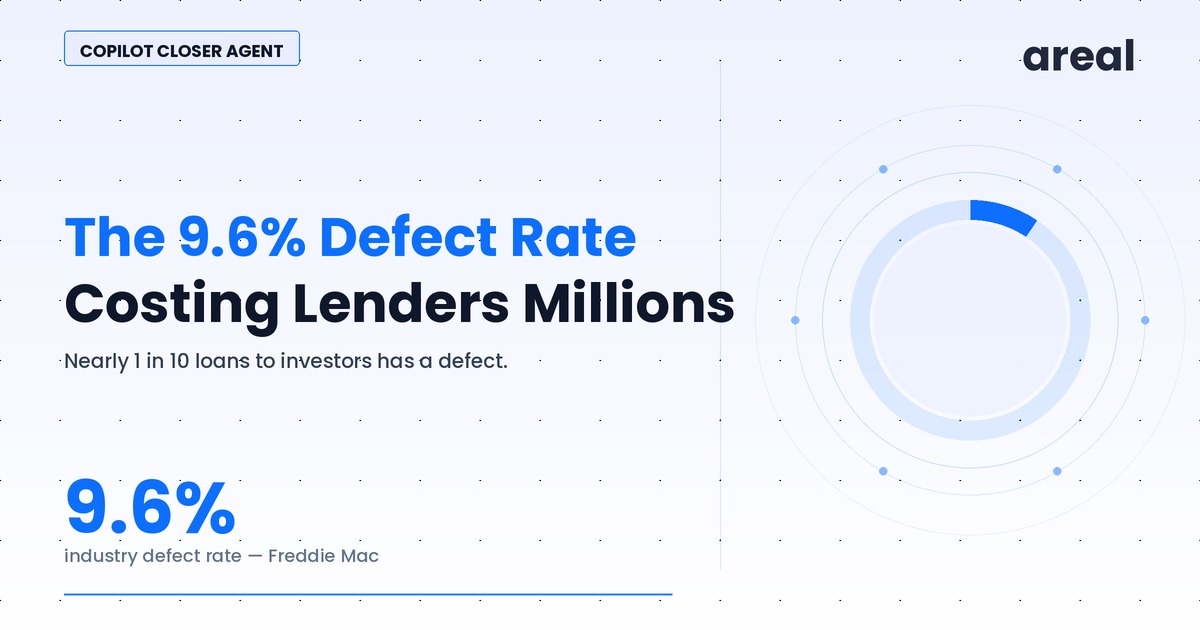
Freddie Mac's data is unambiguous: without systematic quality control at the post-closing stage, the defect rate on mortgage loan files runs at 9.6%. Nearly one in ten loans delivered to investors contains an error significant enough to flag — a missing document, an incorrect date, an unsigned page, a compliance discrepancy that should have been caught before the file left the lender's hands.
That defect rate has consequences. Investors return defective loans for correction before purchase. Every day a loan sits uncorrected after delivery is a day the lender carries the cost. Loans with uncorrectable defects get repurchased — returned to the lender at the original loan amount, which the lender must then fund from its own balance sheet. Lenders with elevated defect rates face additional scrutiny, tighter delivery requirements, and in some cases, restrictions on their ability to sell loans to certain investors.
The industry has known about this problem for decades. The solution most lenders have deployed is more manual review — more post-closing staff, more detailed checklists, more rounds of review before delivery. That approach has a limit: at some level of volume and complexity, adding reviewers doesn't bring the defect rate to zero. It brings it down — at significant cost — and the errors that remain are still there when the loan reaches the investor.
Automated post-closing review changes what's possible.
Post-closing review is the verification step that happens after a loan closes and before it's delivered to an investor or securitized. The scope varies by lender, loan type, and investor requirement, but the core tasks are consistent.
Document completeness verification. The closed loan package must include every document the investor requires for purchase. Agency delivery requirements for Fannie Mae and Freddie Mac specify exactly which documents must be present, in what form, and with what authentication. Non-agency investors have their own lists. A missing document at delivery triggers a deficiency notice — and the clock starts on correction.
Signature, notarization, and dating verification. Every required signature must be present. Every required initial. Every notary stamp and acknowledgment. Recording information must be filled in for recorded documents. Dates must be consistent and within required windows. In a closing package that may run 400 to 600 pages, any of these can be missed — and each miss is a defect.
Data integrity verification. Key data points — loan amount, interest rate, term, borrower name, property address — must be consistent across every document in the file. A discrepancy between the note and the closing disclosure, or between the title policy and the recorded deed, is a defect that will be caught at the investor level if it isn't caught before delivery.
Compliance verification. TRID disclosures must be within tolerance. Right of rescission timing must be correct on refinances. State-specific disclosures must be present for the applicable jurisdiction. High-cost loan thresholds must have been properly assessed and disclosed. These compliance checks are non-negotiable for investor delivery.
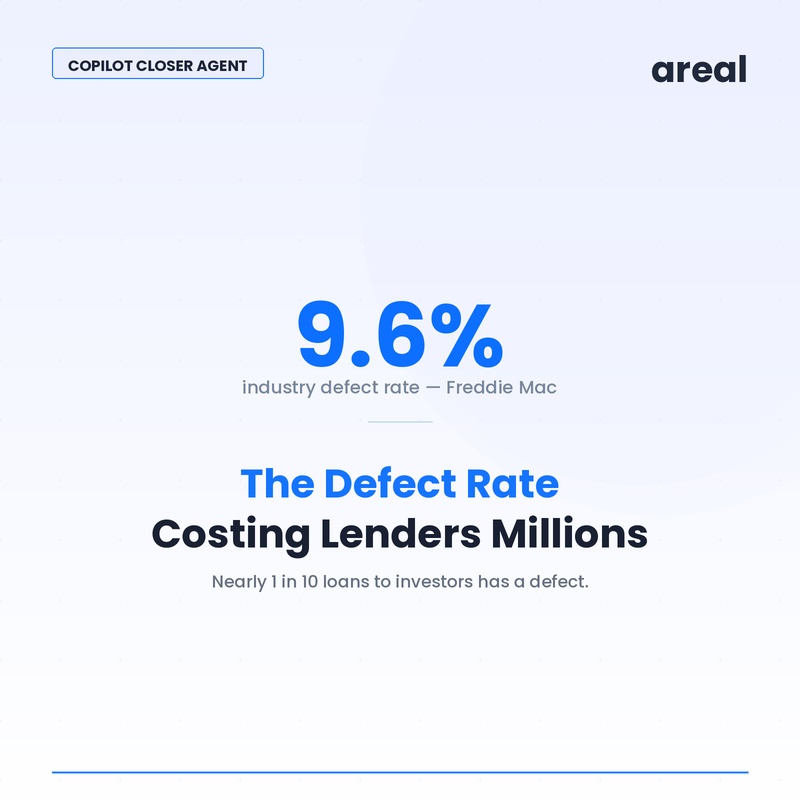
The 9.6% defect rate isn't evenly distributed across loan types or operations. It concentrates in the places where manual review is weakest: high-volume operations processing loans faster than review capacity allows, non-QM and jumbo loans with complex documentation requirements, and operations where post-closing review is treated as an afterthought rather than a defined quality control process.
The structural problems with manual post-closing review:
• Volume mismatches. Post-closing review teams are rarely sized to match origination volume. When volume spikes — seasonal, campaign-driven, or rate-related — the review backlog grows and review quality degrades under time pressure.
• Documentation complexity. A post-closing package for a standard conforming loan might be 150 to 200 pages. A non-QM or jumbo loan can run 400 pages or more. Manual review of a 400-page file for a complete list of defects, under time pressure, is not a reliable process.
• Inconsistent standards. Post-closing review is only as consistent as the reviewers applying it. Training gaps, reviewer fatigue, and the absence of automated rule enforcement create variation in what gets flagged — and what gets missed.
• Late defect discovery. When defects surface after investor delivery, the cure options are limited and expensive. Repurchase demands, indemnification agreements, and investor relationship damage are the downstream costs of defects that weren't caught internally.
Areal's Copilot Closer Agent applies document AI to post-closing review, running systematic verification against the complete loan file rather than a sample or a spot-check.
The review process covers:
• Document completeness. Every document required for the loan type is verified as present and correctly identified. Missing documents are flagged by name, not by category.
• Data integrity. Critical data points — borrower information, loan terms, property data, closing dates — are extracted from documents and cross-referenced across the file. Discrepancies are flagged at the field level with the specific documents in conflict identified.
• Signature and execution verification. Signature and initials requirements are checked against completion. Missing or incomplete execution is flagged by document and page.
• Regulatory compliance checks. TRID timing requirements, right of rescission periods, and applicable state disclosure requirements are verified against documented dates.
• Investor guideline validation. For loans with specific investor delivery requirements, the review can be configured to check against those guidelines — flagging issues before the file is submitted rather than after it's rejected.
Post-closing review done manually takes 40 to 90 minutes per file depending on loan type and package complexity. Automated review runs in minutes — and it runs against the complete file, not a sample.
For a team processing 100 loans per month, the time difference is significant. But the more important shift is qualitative: reviewers move from doing the review to managing the exceptions. Rather than reading through a 200-page file to find problems, they're looking at a report of flagged items that need resolution.
That shift changes what post-closing review can accomplish at scale. A team that was previously capacity-constrained to reviewing 80% of files can review 100% — with higher accuracy and in less time.
There's a case for post-closing automation that's entirely about investor relationships, separate from the internal efficiency argument. Investors track defect rates by seller. Lenders with consistently clean files get faster purchase decisions and better relationships with their secondary market buyers. Lenders with recurring defects face increased scrutiny, delayed purchases, and — in the worst cases — repurchase demands and relationship termination.
For lenders with secondary market ambitions — growing non-agency volume, expanding to new investors, improving execution on existing relationships — post-closing defect rates are a strategic variable, not just an operational one.
Automated post-closing review is the most direct lever for improving those rates at scale. The accuracy doesn't degrade with volume. The coverage doesn't depend on reviewer capacity. And the audit trail it creates — documenting every check performed and every defect identified — provides the documentation investors need to trust the process.
Talk to Areal about what automated post-closing review looks like for your operation.
We'll show you which workflows to automate first — and the exact ROI for your volume.
Book a Demo →