Marketing
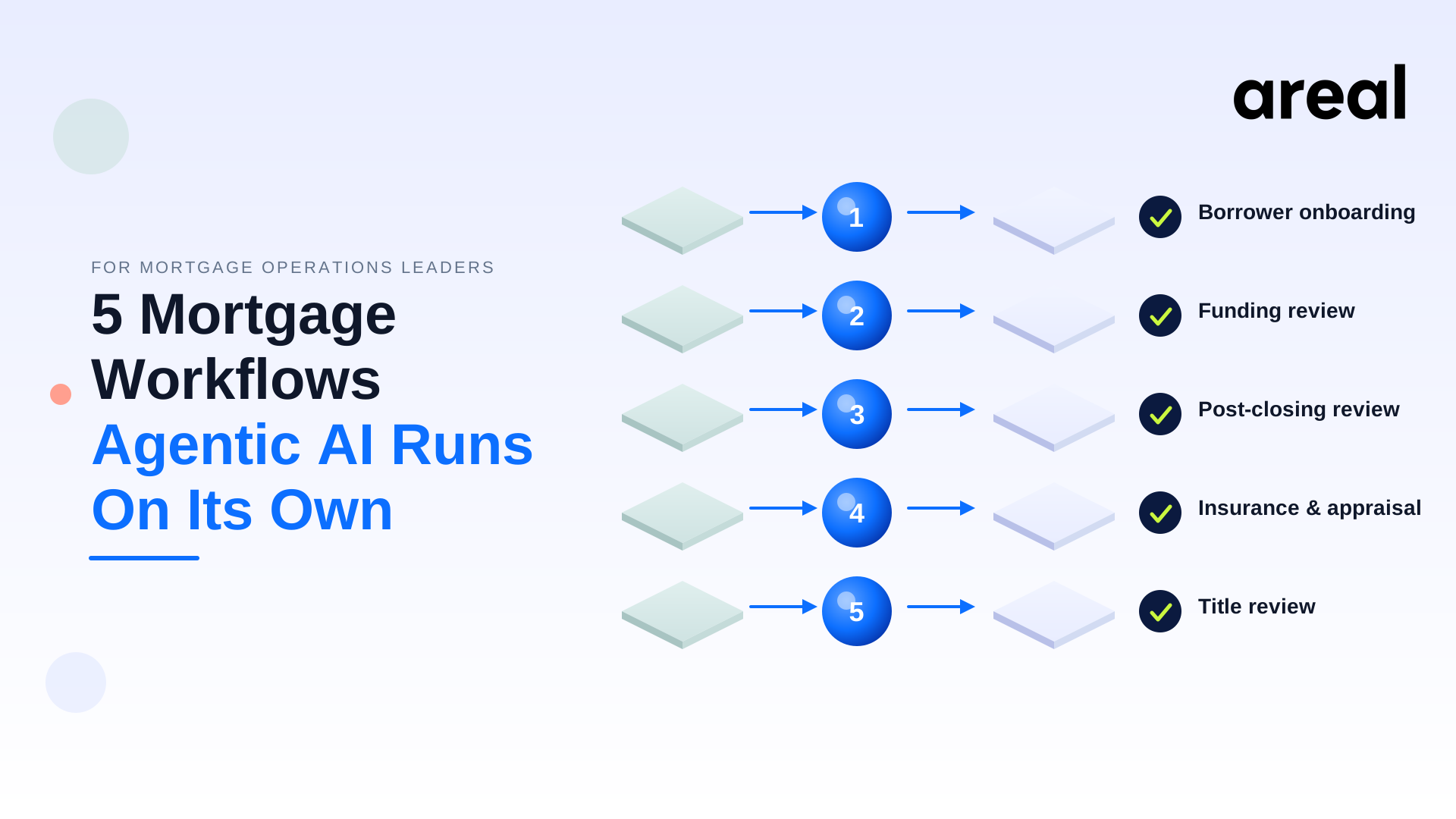
Mortgage operations leaders are no longer asking whether AI can help — they're asking which workflows it can actually run without a human running the playbook. Generic AI can't do this. But specialized agentic AI for mortgage — purpose-built on millions of mortgage documents and integrated into the LOS — already runs five distinct workflows end-to-end at top-tier lenders. This piece walks through each one, what it replaces, and the hours per loan it recovers.
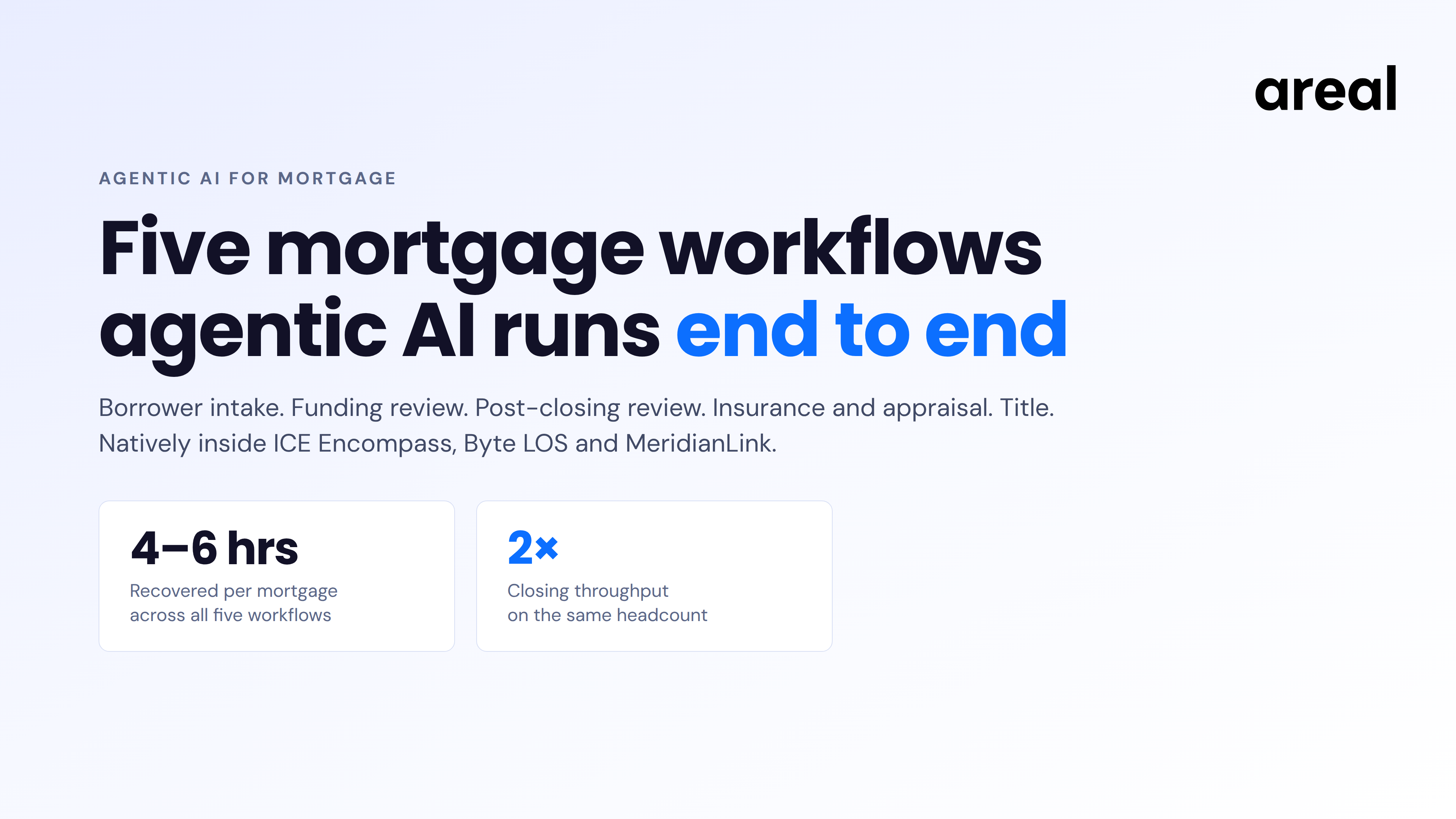
The benchmark we use throughout: a complete agentic AI deployment across these five workflows recovers 5-8+ hours per loan and supports doubling closing throughput with the same headcount.
The manual workflow: Borrowers upload W-2s, pay stubs, bank statements, tax returns, and supporting documents. A processor opens each one, classifies it, splits bundled PDFs, removes duplicates, and keys data into the LOS. This takes 1-3 hours per loan and creates a cold start every time a new borrower comes in.
The agentic AI workflow: The moment a document hits the borrower portal, the agent classifies every page across 1,500+ document types, splits bundled PDFs automatically, detects duplicates, extracts the key data, and populates the LOS. The processor sees a complete, validated package on their first look — not a pile of PDFs to sort.
Where humans stay in the loop: Exception review only. The agent flags missing documents, expired IDs, or income data that doesn't reconcile.
Hours saved per loan: 1-3 hours
Learn how Areal Copilot Processor Agent runs this workflow
The manual workflow: A funder opens the closing package and verifies dozens of small things — borrower signatures on every required page, correct notary dates, matching loan amounts, complete exhibits. This takes 30+ minutes per loan, more if the package has issues. Mistakes here delay funding and cost lenders revenue per day of delay.
The agentic AI workflow: The agent reads the entire funding package, validates signatures and notary stamps at 99% accuracy on critical fields, confirms loan amounts match across the LOS and the closing docs, and surfaces any missing or wrong items as a short flagged list. The funder triages the flags instead of reading every page.
Where humans stay in the loop: Reviewing the flagged exceptions, signing off on the final funding decision, handling investor-specific edge cases.
Hours saved per loan: 20-40 minutes
See how Copilot Closer Agent runs funding review
The manual workflow: Post-closing teams traditionally review 400-600 pages per loan against investor-specific checklists. They verify that every required document, page, stamp, and signature is present and in the right order. The Freddie Mac defect rate sits around 9.6% — meaning roughly one in ten loans gets sent back, and someone upstream spends an afternoon fixing it. Time per loan: 60-90+ minutes.
The agentic AI workflow: The agent matches the closing package against each investor's checklist, detects missing pages, missing stamps, missing signatures, and mismatched data, and assembles compliant investor-ready packages automatically. Defect rate drops well below the 9.6% baseline because every loan is checked, not just sampled.
Where humans stay in the loop: Investor-specific judgment calls, audit response, post-closing QC supervision.
Hours saved per loan: 40-80 minutes
Reduction in defect-rate exposure: Meaningful — every loan is validated against requirements, not sampled
The manual workflow: A processor reviews the homeowners insurance binder and the appraisal report against the loan file — checking coverage amounts, named insureds, mortgagee clauses, property addresses, appraised values, comparables, and a few dozen other fields. This is 40-60 minutes per loan, often interrupted by waiting on third parties.
The agentic AI workflow: Two distinct agents run in parallel. The insurance agent extracts coverage data, validates the mortgagee clause language, and confirms named insureds. The appraisal agent extracts values and key fields and flags missing comparables or unusual valuations. Both push validated data back to the LOS and notify the processor only when something needs human attention.
Where humans stay in the loop: Insurance carrier disputes, appraisal escalations, exception handling on unusual property types.
Hours saved per loan: 40-60 minutes total across both verifications
The manual workflow: A closer or title coordinator reviews the title commitment, settlement statement, and supporting title documents — verifying chain of title, lien position, exception language, fee accuracy, and matching the title CD to the lender CD line by line. This takes 2-3 hours per loan and is one of the most error-prone steps in closing.
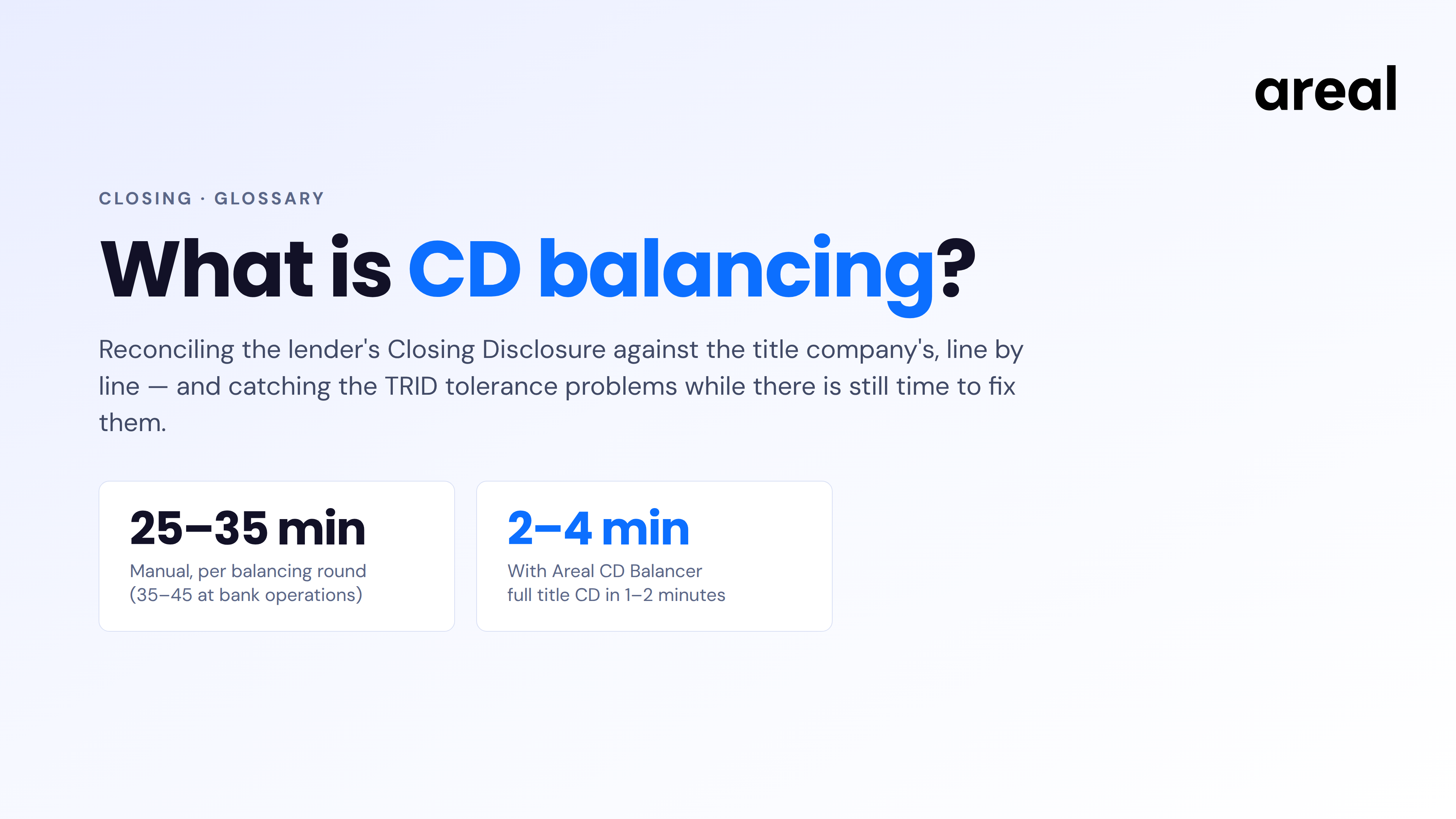
The agentic AI workflow: The agent reads the title commitment and settlement statement, verifies fee math, compares title CD to lender CD across all 50-60 line items, flags discrepancies, drafts the exception emails to the title company, and pushes balanced fees back to the LOS once corrections are confirmed. CD balancing alone goes from 45-65 minutes per session to 2-4 minutes.
Where humans stay in the loop: Title curative decisions, escalations on exceptions, final closer sign-off.
Hours saved per loan: 2-3 hours total across title review and CD balancing
Learn how Areal CD Balancer runs the fee reconciliation step
For a lender closing 10,000 loans per year, deploying agentic AI across all five workflows produces:
This is not a theoretical case study. Top-tier lenders — including all Guaranteed Rate Companies, Canopy Mortgage, and many more — already run these workflows in production today.
You don't have to deploy all five at once. The most common starting point is CD balancing — it's the highest ROI per hour saved, the lowest implementation friction, and the workflow with the clearest, most measurable outcome. From there, lenders typically expand to funding review and post-closing within the first 60-90 days.
The second most common starting point is post-closing review, especially for lenders carrying meaningful repurchase risk or working with investor checklists that change frequently.
Both starting points share the same prerequisite: a platform with deep document AI accuracy on critical fields (signatures, notary stamps, dates, amounts) and native bidirectional LOS integration. Without those two, agentic AI breaks down at the exception layer — flagging issues that humans then have to read 600 pages to verify.
Title review (including CD balancing) saves the most: 2-3 hours per loan combined. Post-closing review is second at 40-80 minutes. Borrower onboarding is third at 1-3 hours.
Modern agentic AI handles routine exceptions — drafting correction emails, updating the LOS, notifying parties — and flags the genuinely complex ones for human review. The strongest platforms reduce human review work by 80-95% while keeping humans in the loop on judgment calls.
Lenders closing 200+ loans per month see clear ROI in year one. Below that volume, the implementation cost vs. hours saved math gets tighter — but lenders working with high investor scrutiny or thin operating margins still see strong returns.
In the deployments we've seen, no — they redeploy them. Closers handle more loans per month with less overtime. Post-closing teams move from page-by-page review to investor relationship management and QC supervision. Hiring slows, but headcount usually stays steady while throughput doubles.
A pilot typically runs in 30 days, full production in 60-90 days for a single workflow, depending on LOS integration depth. Multi-workflow deployments stage over 3-6 months.
Native bidirectional integration with the LOS (ICE Encompass, MeridianLink, Byte LOS) is the foundation. Without bidirectional updates, agentic AI can extract data but can't take action — which means humans still do the final keystrokes.
The mortgage operations teams already running these five agentic AI workflows aren't doing more work — they're doing different work. They handle exceptions instead of paperwork. They scale throughput without scaling headcount. They cut defect rates because every loan is validated, not sampled.
The category has matured. The question for every mortgage technology buyer in 2026 is no longer whether to deploy agentic AI — it's which of these five workflows to start with, and how fast.
See how Areal Copilot Agent runs all five workflows or book a 20-minute walkthrough to see the platform on real loans. New to agentic AI? Read What Is Mortgage Automation? The 2026 Guide for the foundational context.

We'll show you which workflows to automate first — and the exact ROI for your volume.
Book a Demo →