Mortgage operations has seen two waves of technology. The first was digitization — moving documents, data, and workflows off paper and into systems. The second was automation — using rules-based tools to handle repeatable tasks like condition tracking, document requests, and status updates.
Both waves helped. Neither solved the core problem.
The bottleneck in mortgage operations has never been forms or databases. It’s been the need for human judgment on every piece of information that flows through a loan file — classifying a document, verifying a figure, flagging an exception, updating a record, notifying a party. Each step requires someone to look at something, decide what it means, and take action. Multiply that by 400 documents per loan, multiply by 200 loans per month, and you have a staffing math problem that digitization and rule-based automation can’t solve.
Agentic AI changes that math.
The word gets used loosely, so it’s worth being precise. In a mortgage context, an AI “agent” isn’t a chatbot, a workflow template, or an automation rule. It’s an AI system that:
• Monitors a specific set of data sources, documents, and events
• Understands what it’s looking at — not just matching patterns, but interpreting content
• Acts based on what it finds — updating records, flagging exceptions, sending notifications, triggering downstream steps
• Does this continuously, without waiting to be triggered by a human
Traditional automation tools respond to explicit triggers: a document is uploaded, a button is clicked, a deadline is reached. An agentic AI doesn’t wait. It monitors the inputs it’s been assigned to watch and works continuously — during business hours, after hours, at month-end when volume spikes and your team is stretched.
The distinction matters practically. A rule-based automation says: “When a document is uploaded, classify it.” An agentic AI says: “I’m watching this loan. A new document was uploaded. I’ve classified it, extracted the relevant data, cross-referenced it against the existing loan data, identified two discrepancies against investor guidelines, and flagged them for review — along with the specific pages and fields that need attention.” All of that happens before a human opens the file.
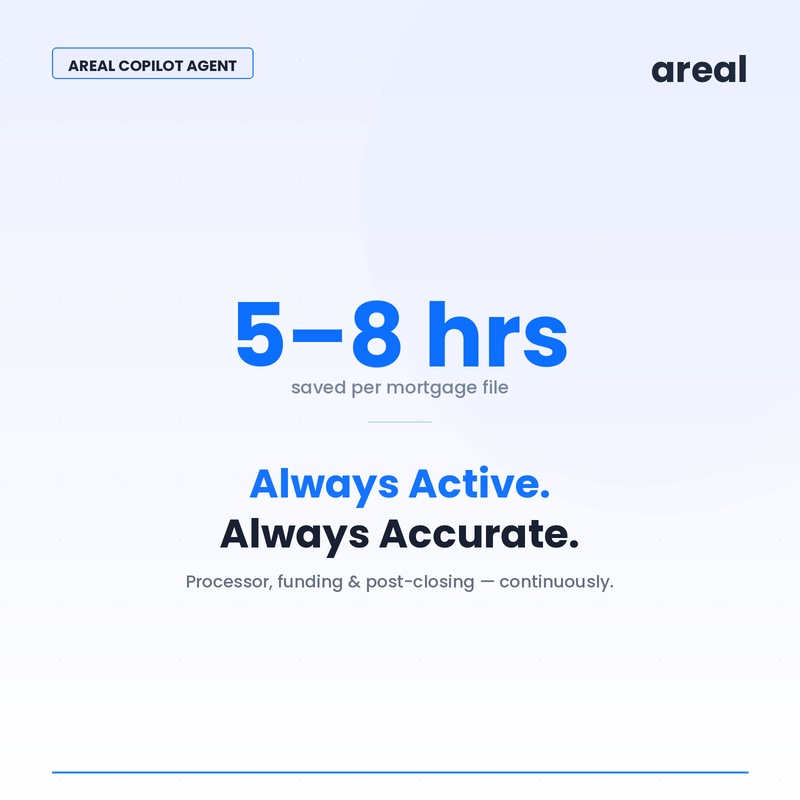
Areal launched the Copilot Agent as the first agentic AI system purpose-built for mortgage operations. Unlike AI tools that respond to prompts or automate single tasks, the Copilot Agent operates as a persistent workflow layer — monitoring incoming documents, executing multi-step review processes, flagging exceptions, and handing off to human reviewers only when judgment is required.
It runs on the same document AI infrastructure that powers Areal's other products: 99% classification accuracy, 1,500+ document types, trained on mortgage-specific data. But the Copilot Agent applies that capability across entire workflows, not just individual tasks.
What that means operationally:
• No queue management. Documents that arrive at 11 PM are processed at 11 PM, not the next morning when a closer logs in.
• No task switching. The agent doesn't lose context between documents or need to reload institutional knowledge about a file. It holds the full picture of a loan in progress.
• No variable accuracy. Performance doesn't degrade after 50 files or at the end of a shift. The same rules apply to the 200th document as the first.
The operational leverage of agentic AI becomes clearest at volume. A closer managing 30 files simultaneously is making constant triage decisions: which file needs attention now, which condition is blocking funding, which document arrived that needs review.
The Copilot Agent eliminates most of that triage. It monitors all active files, identifies what changed, and surfaces only the items that require human action. A closer using the Copilot Agent doesn't ask "what do I need to work on" — the system tells them, with the relevant context already assembled.
This isn't a workflow dashboard. It's active orchestration: the agent is continuously running the process, not just displaying its status.
At volume — 100 loans in pipeline, 200, 500 — the gap between agentic AI and traditional automation grows significantly. Rule-based automation handles the tasks it was configured for. Agentic AI handles the variation: the document that arrived in an unexpected format, the condition that was partially satisfied but requires interpretation, the funding package where one item was updated and the rest need to be re-verified.
It's worth being direct about what Copilot Agent doesn't do. It doesn't make credit decisions. It doesn't negotiate with borrowers. It doesn't exercise judgment in genuinely ambiguous situations where a human closer's knowledge of a specific file, borrower, or investor relationship is material.
What it does is eliminate the work that shouldn't require that judgment in the first place: routine document review, tolerance checking, data extraction, condition tracking, and the coordination overhead that consumes a disproportionate share of a closer's day.
The goal isn't to remove humans from mortgage operations. It's to return them to the work that actually requires human expertise — the exceptions, the edge cases, the borrower interactions where experience and judgment matter.
Most lenders who evaluate the Copilot Agent start with a specific workflow: funding review, post-closing, or initial document intake. That's the right approach — agentic AI is most legible when you can measure its impact against a defined process with known cycle times and error rates.
The onboarding process is designed to work with your existing LOS and document management stack. The Copilot Agent doesn't require replacing infrastructure — it connects to what you already have and applies workflow automation on top.
If your operation is processing volume that has outpaced your current team's capacity — or if you're anticipating growth and don't want to solve it by adding headcount — agentic AI is worth evaluating seriously. The technology is mature, the accuracy is documented, and the operational case is straightforward.
Talk to Areal about what the Copilot Agent looks like in your workflow.
We'll show you which workflows to automate first — and the exact ROI for your volume.
Book a Demo →