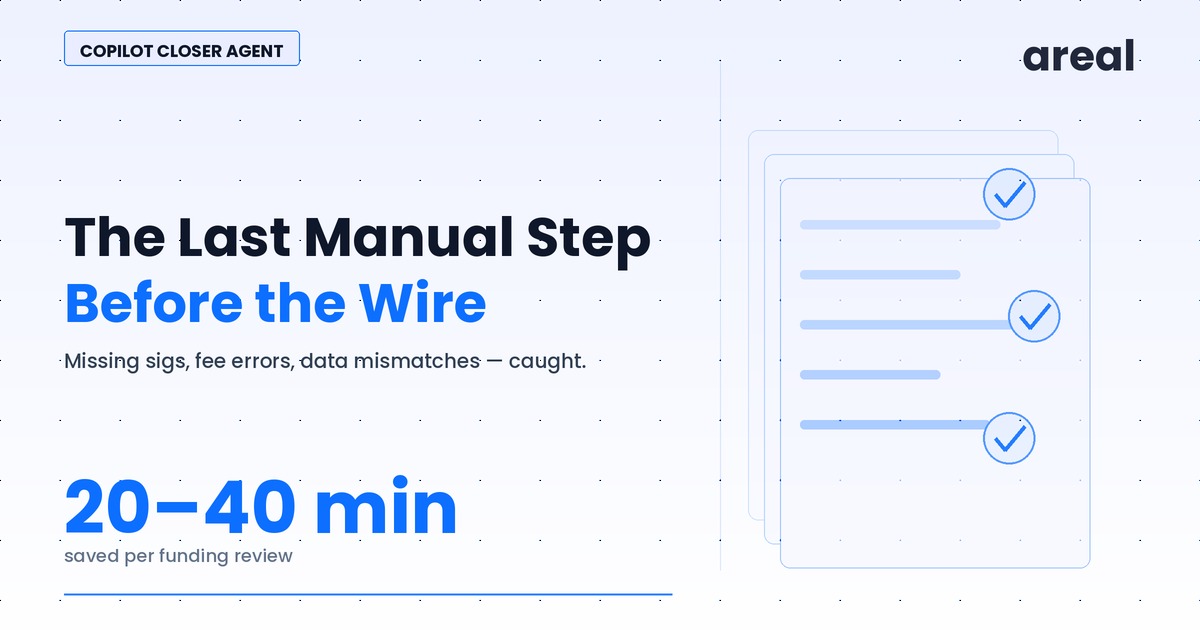
The wire doesn't go out until funding review is done. That's the constraint every closing and funding team works around — and for most lenders, it's a constraint enforced by someone manually reading through a closing package to make sure everything that needs to be there is there, signed, dated, and correct.
Funding review sits at the end of the loan pipeline. By the time a file reaches the funder, it has passed through origination, processing, underwriting, closing, and often multiple rounds of condition clearing. The assumption is that what arrives at funding is close to complete. The reality is that closing packages routinely contain errors — missing signatures, incorrect dates, pages out of order, conditions not fully satisfied — that a funder has to catch before the wire is authorized.
Missing them is not an option. Funding a loan with a defective closing package exposes the lender to investor repurchase risk, delays in loan sale, and potential regulatory scrutiny. The cost of a defect caught after funding is significantly higher than the cost of catching it before.
The cost of catching it manually, on every loan, every day, is measured in time — and it's a cost the industry has accepted as unavoidable for too long.
Mortgage funding review varies by lender, loan type, and investor, but the core task is consistent: verify that the closing package satisfies all outstanding funding conditions before authorizing the wire transfer.
For a conventional purchase loan, that typically means:
Document completeness check. Confirming that all required documents are present — the note, the deed of trust or mortgage, the closing disclosure, the right of rescission (on refinances), the title insurance commitment, homeowners insurance documentation, and the closing protection letter, among others. Missing pages or missing documents are the most common funding condition failures.
Signature and notarization verification. Every required signature, initial, and notary stamp needs to be present and in the right place. A missed initial on page 3 of the note is a defect. A notary acknowledgment with the wrong date is a defect. In a manually reviewed package of 80 to 150 pages, these are easy to miss.
Data accuracy verification. Key figures — loan amount, interest rate, payment amount, closing date — must be consistent across documents. A discrepancy between the note and the closing disclosure, or between the closing disclosure and the title commitment, is a funding condition failure.
Outstanding condition clearance. Any conditions flagged during underwriting that haven't been fully documented need to be confirmed before funding. This often means cross-referencing the condition list against the documents in the closing package and confirming that each condition has been addressed.
Wire instruction verification. Confirming that the wire amount, recipient, and account information match the closing disclosure and the title company's disbursement instructions.
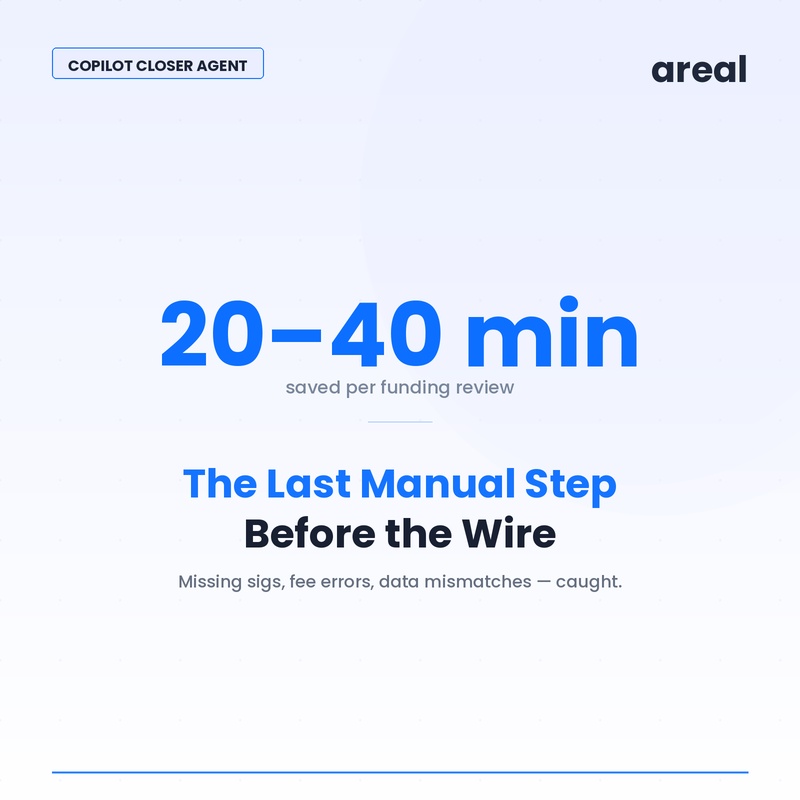
On a straightforward purchase loan with a clean package, an experienced funder can complete this review in 20 to 30 minutes. On a more complex loan — jumbo, non-QM, construction, or any loan with a complicated condition list — the same review takes 45 to 60 minutes or longer.
At 20 fundings per day on a busy team, that's 400 to 600 minutes of daily review time, plus rework when defects are found and the file has to go back to closing.
Funding review done manually under time pressure produces a predictable failure pattern. The checklist exists, but the execution is inconsistent — closers working through 15 or 20 funding packages in a day make different decisions about how much time to spend on each item, what constitutes a satisfactory review, and which conditions can be waived or deferred.
The specific failure modes:
• Document completeness errors. A document that was submitted but not indexed, or indexed but not reviewed, passes through manual checklist review because the checker confirms the file is present, not that it's been read.
• Signature and date verification gaps. Funding packages contain dozens of signature lines across multiple documents. Manual review catches the obvious misses; it frequently doesn't catch the initialed page that was skipped, the date that doesn't match the closing date, or the signature block that was completed incorrectly.
• Tolerance and fee errors. CD balancing errors that weren't caught earlier in the process arrive at funding. Under time pressure, these are sometimes waved through rather than escalated — creating a cure liability that surfaces post-closing.
• Wire instruction errors. Manual verification of disbursement amounts against funding conditions is where fraud risk concentrates. Wire fraud in mortgage closing is a documented, growing problem, and manual verification is the last line of defense — unless it's been automated.
Areal's Copilot Closer Agent applies document AI to the funding checklist, running automated verification against every document in the package before the closer begins manual review.
The system checks:
• Document completeness. Every required document is identified and confirmed present. Missing items are flagged with specific identification — not a generic "incomplete" alert, but a named document that hasn't been received.
• Data accuracy. Key data points — borrower names, loan amounts, property addresses, closing dates — are extracted from documents and cross-referenced. Discrepancies are flagged at the field level.
• Signature verification. Signature and initials fields are checked for completion. Missing or incomplete signatures are identified by document and page.
• CD tolerance compliance. Fee tolerance calculations are run against the final CD. Any tolerance violation is flagged before the package is approved for funding.
The result is that when a closer opens a funding package, the preliminary review has already been completed. They're looking at a report of exceptions — items that need human judgment — not starting from scratch with a checklist.
Funding delays are visible to borrowers in a way that most operational problems aren't. A borrower who has waited 30 to 45 days to close experiences a same-day funding delay as a significant failure, regardless of what caused it.
For purchase transactions, the impact extends to sellers and real estate agents. A delayed funding affects possession dates, moving schedules, and the downstream transactions that depend on the sale completing. Every missed same-day funding creates a relationship risk with the referral sources who sent the loan.
Automated funding review reduces same-day funding failure rates by catching the issues that cause delays — document errors, missing items, tolerance violations — before the package is submitted for funding, not after it's been rejected.
Funding review is one of the highest-leverage places to apply document automation because the stakes are well-defined: same-day funding rates, cure rates, and fraud exposure are all measurable, and the cost of getting it wrong is immediate.
Areal's Copilot Closer Agent connects to your existing LOS and document management system. Implementation doesn't require replacing infrastructure — it layers automated verification on top of your current process.
If your operation is running same-day funding failure rates above 2%, or if you're absorbing more than two or three fee cures per month, automated funding review is worth evaluating. The ROI is direct and measurable.
Talk to Areal about what Copilot Closer Agent looks like in your closing operation.
We'll show you which workflows to automate first — and the exact ROI for your volume.
Book a Demo →