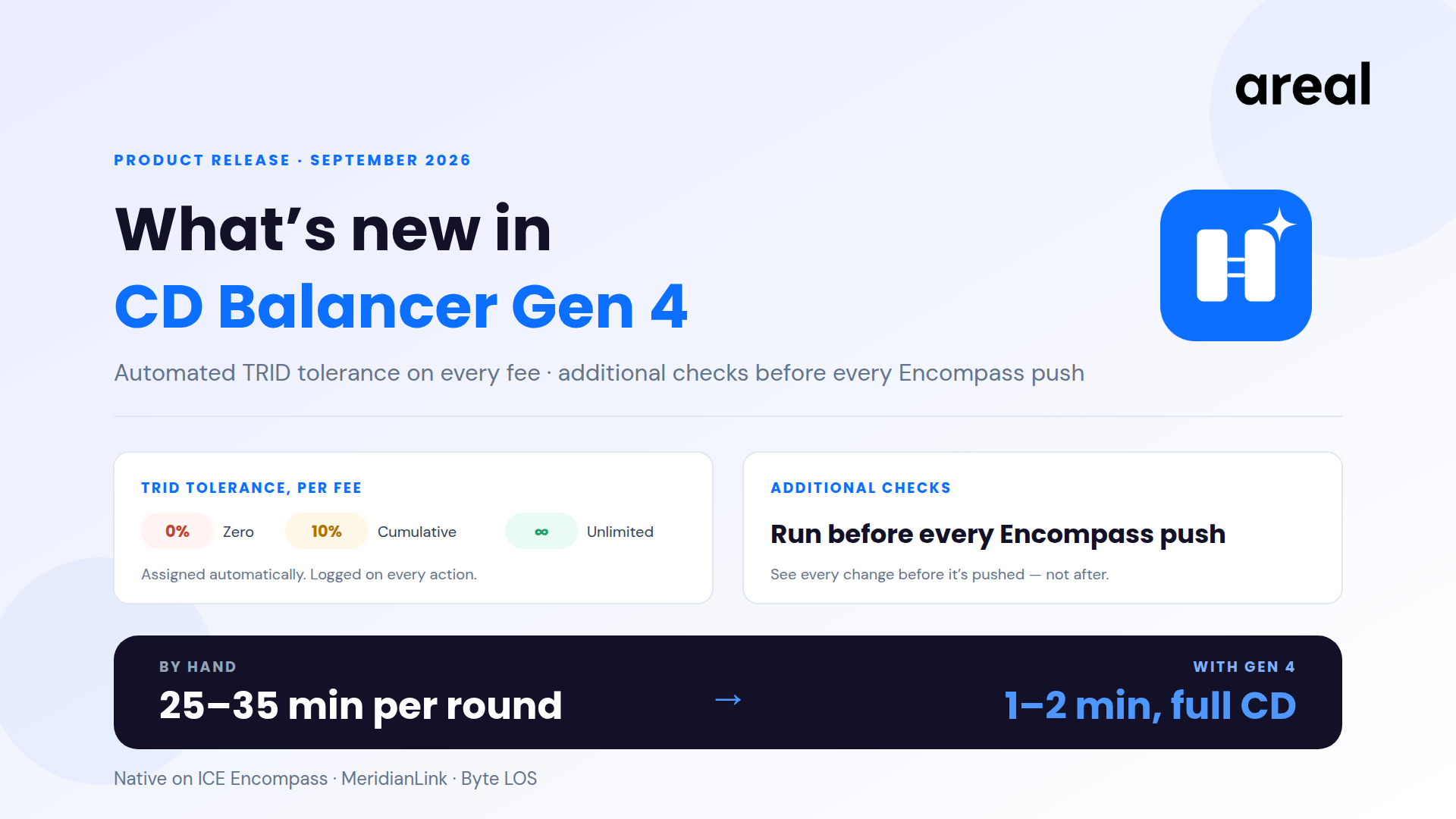
Areal CD Balancer Gen 4 adds three things to the industry's #1 CD balancing solution: automated TRID tolerance categorization on every fee, real-time visibility into how each change writes back to the LOS, and a balancing engine that reconciles a full title CD against every LOS fee in one to two minutes. It ships today for lenders on ICE Encompass, MeridianLink and Byte.
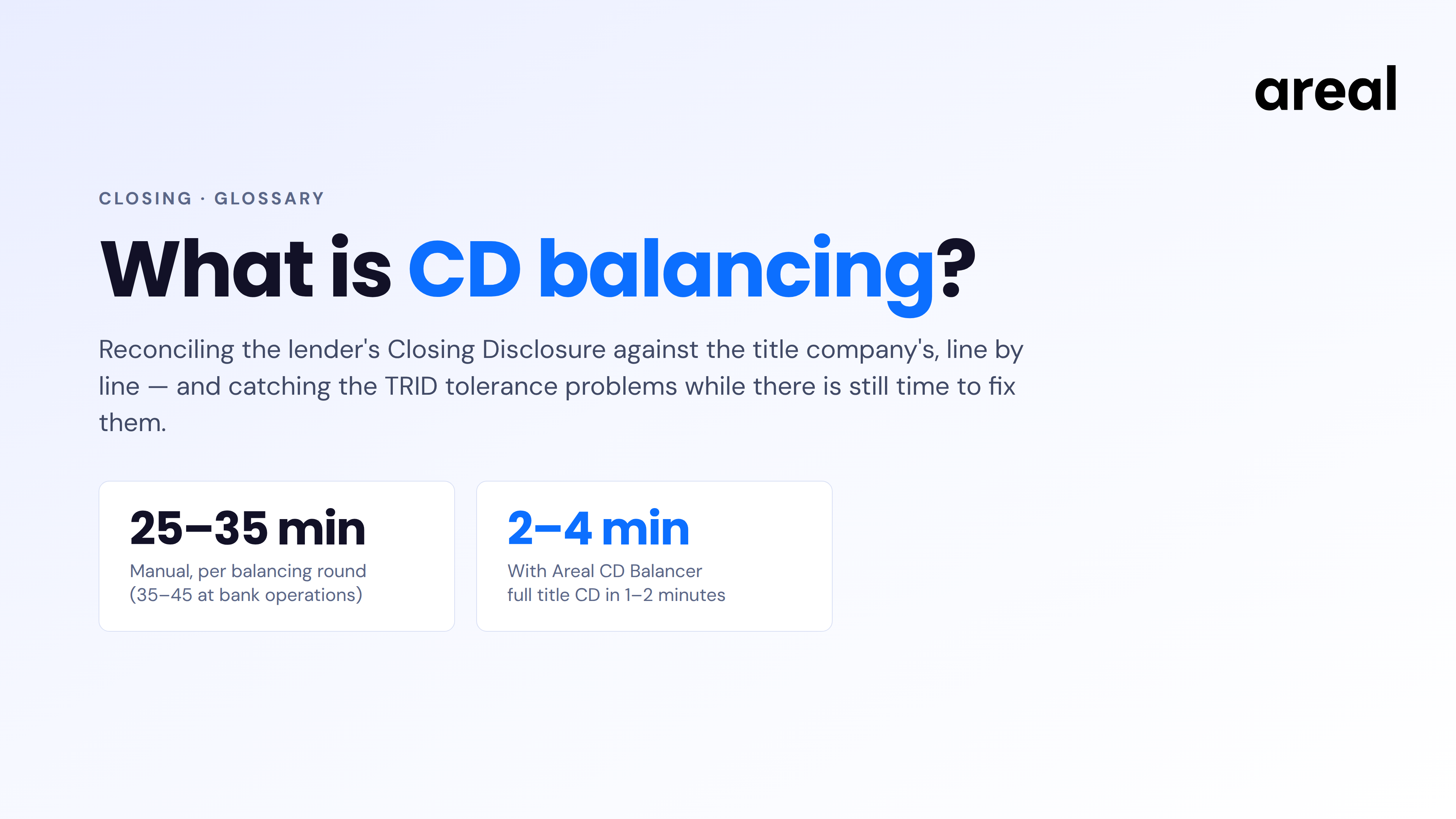
CD balancing is the reconciliation step near the end of a mortgage closing where the lender's Closing Disclosure is matched, line by line, against the title company's CD or settlement statement. A CD carries 50 to 60 fee line items. Every one has to agree, and every one has to sit inside the TRID tolerance it is held to, or the lender is looking at a cure or a delayed closing.
Done by hand, most closing teams spend 25 to 35 minutes per balancing round. Bank operations typically run longer — 35 to 45 minutes — because they layer deeper compliance review into the same step. That is process depth, not slower closers. Most loans need three or four rounds. The arithmetic lands at 1 to 2 hours per loan on fee reconciliation alone, and it lands hardest at month-end, when volume peaks and there is the least slack to absorb an error.
With Areal, a balancing round takes 2 to 4 minutes, and Gen 4 reconciles a full title CD in 1 to 2 minutes. The platform handles about 95% of matching automatically and surfaces only the exceptions that need a human decision. Learn more about Areal CD Balancer and mortgage automation.
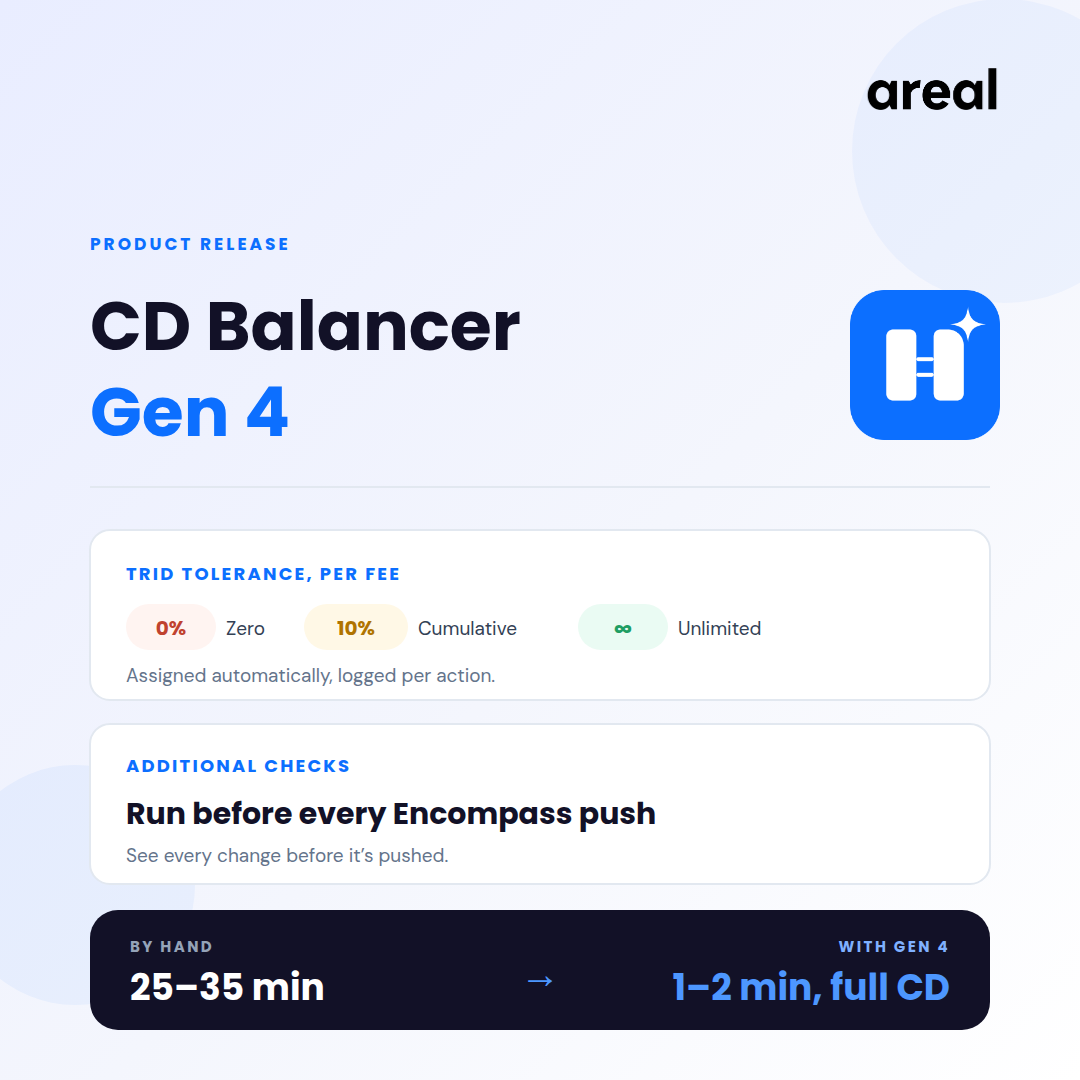
Every fee on a Closing Disclosure falls into one of three TRID tolerance categories: zero tolerance, 10% cumulative tolerance, or unlimited tolerance. Which bucket a fee lands in determines how far it can move between the Loan Estimate and the Closing Disclosure before it becomes a compliance problem.
Gen 4 sorts every fee into the right category automatically and records how each balancing action — every match, override and adjustment — affects that fee's standing inside the tolerance framework. Compliance teams get the reasoning at the moment it happens instead of reconstructing it during an audit months later.
Previously a closer balanced a fee, pushed it, and checked afterward if something looked wrong. Gen 4 shows the destination field, the before-and-after value, and the downstream effect of every change before it is pushed. That visibility is the difference between a tool you verify and a tool you act on.
The new balancing engine ingests an entire title CD and reconciles it against every fee already in the LOS in one to two minutes. That is a step past fee-by-fee exception review: it is fast enough to run full balancing on the final CD, the version closest to closing, where turnaround matters most and there is the least room for a manual re-check.
| Manual balancing | CD Balancer Gen 3 | CD Balancer Gen 4 | |
|---|---|---|---|
| Time per balancing round | 25–35 min (banks 35–45) | 2–4 min | 2–4 min, full CD 1–2 minutes |
| Scope | Every line, by hand | Fee-by-fee exception review | Full CD, including final CD |
| TRID tolerance categorisation | Manual, reconstructed at audit | Manual reference | Automatic, per fee, logged |
| LOS write-back | Push, then verify | Push, then verify | Previewed before push |
| Audit trail | Assembled after the fact | Action log | Action log mapped to the TRID rule applied |
Errors cluster where volume is highest. Freddie Mac has put the defect rate on loans reviewed without automation at 9.6% — and post-closing is where those defects surface, long after the closer has moved on to the next file.
The compliance argument is the one that holds up. A tolerance-aware system applies the same test to every fee on every loan from every closer, and writes down which rule it applied. That is a uniform compliance posture, not a faster version of an inconsistent one. The hours saved — 1 to 2 per loan — are the supporting argument, not the pitch.
Yes. Areal CD Balancer has a native integration with ICE Encompass and supports MeridianLink and Byte LOS. It runs as an AI layer on top of the LOS the lender already has — no migration, no replacement system of record. Fees are read off the title CD, matched to the correct LOS field, checked against the TRID tolerance category that governs them, and written back with a full audit trail.
Each generation of CD Balancer sits on the same foundation: millions of mortgage pages processed weekly, feeding a proprietary, mortgage-specific dataset that makes fee-matching logic more reliable with every release. Gen 4's tolerance categorisation and write-back tracking are the newest layer on that foundation — an extension, not a rebuild. CD Balancer is in production with lenders including all Guaranteed Rate Companies, Canopy Mortgage, and many more. See also Areal Copilot Agent and mortgage underwriting automation.
Areal CD Balancer Gen 4 is available today. Request a walkthrough and we will run it against your own CDs.
A CD balancer is software that reconciles the lender's Closing Disclosure against the title company's CD or settlement statement, line by line, and checks each fee against the TRID tolerance category that governs it. Areal CD Balancer compares the two documents, flags every discrepancy, and writes corrected fees back into the loan origination system automatically.
CD balancing is the step where the lender and the settlement agent match every fee, closing cost and credit on the Closing Disclosure before final documents are signed, and confirm those figures stay inside TRID tolerance against the original Loan Estimate. A CD carries 50 to 60 line items and most loans need three or four rounds.
Manually, 25 to 35 minutes per round for most closing teams and 35 to 45 minutes at bank operations that fold deeper compliance review into the same step. Across three or four rounds that is 1 to 2 hours per loan. With Areal CD Balancer a round takes 2 to 4 minutes, and Gen 4 balances a full CD in one to two minutes.
Areal CD Balancer is a purpose-built CD balancing product for mortgage lenders and title companies, with native ICE Encompass integration and support for MeridianLink and Byte. It automates fee matching, TRID tolerance categorisation and LOS write-back, and is used in production by lenders including all Guaranteed Rate Companies and Canopy Mortgage.
Yes. The Encompass integration is native, so Encompass stays the system of record and there is no LOS migration. Areal maps unstructured title-agency fees to the lender's Encompass fee lines, applies TRID tolerance logic, and pushes balanced fees back with an audit trail.
No. It handles about 95% of fee matching automatically and routes the remainder to a closer as exceptions. The closer's judgement moves from re-keying 50 to 60 line items to deciding the handful of items that genuinely need a decision.
TRID tolerance is the limit on how much a fee may increase between the Loan Estimate and the Closing Disclosure. Fees fall into zero tolerance, 10% cumulative tolerance, or unlimited tolerance categories. Exceeding the applicable tolerance obliges the lender to cure the difference. Gen 4 assigns each fee its category automatically and logs every action taken against it.
We'll show you which workflows to automate first — and the exact ROI for your volume.
Book a Demo →