AI Tools
CD balancing is the reconciliation step near the end of a mortgage closing where the lender's Closing Disclosure is matched, line by line, against the title company's Closing Disclosure or settlement statement. Every fee, credit, prorated item and payoff figure on one document has to agree with the same item on the other. When the two documents agree, the file is "in balance" and the loan can move to funding. When they do not, the closer works the differences with the settlement agent until they do.
Closers also call this fee reconciliation, CD reconciliation, or simply "balancing the CD." A single residential file typically carries 50 to 60 line items to compare, and a purchase transaction with seller credits, multiple payoffs and prorated taxes carries more.
CD balancing is not a formality. It is where TRID tolerance violations get caught. Under the TILA-RESPA Integrated Disclosure rule, certain fees cannot increase from the Loan Estimate to the Closing Disclosure at all, others can increase only within a 10% aggregate tolerance, and others can change freely. A fee that moves into the wrong bucket and goes uncaught becomes a cure the lender pays for, plus a finding in the next audit. Balancing is the control that catches it while there is still time to fix it.
The lender's closer or closing specialist owns it, working against the settlement agent or title company that produced the other CD. At a bank, a compliance reviewer often works the same file in the same step, which is why bank closing operations take longer per round than independent mortgage banks.
The Closing Disclosure is the federally mandated five-page form the borrower receives at least three business days before consummation. A settlement statement, often an ALTA settlement statement, is the title company's accounting of every dollar moving through escrow, including items that never appear on the borrower's CD. In a purchase transaction the settlement agent frequently produces both. Balancing compares the fee lines that must agree across the two.
The manual process is the same at almost every lender, and it runs in rounds. One round is one full pass through the comparison plus the email that goes back to the settlement agent.
The reason this consumes so much of a closer's day is not the arithmetic. It is that every round is an interruption: the closer puts down whatever else they were doing, reloads the entire context of a file they last touched two days ago, works it for half an hour, sends an email, and picks up something else. Four rounds is four context reloads on a single loan. Multiply that across a closing pipeline at month-end and the switching cost exceeds the comparison cost.
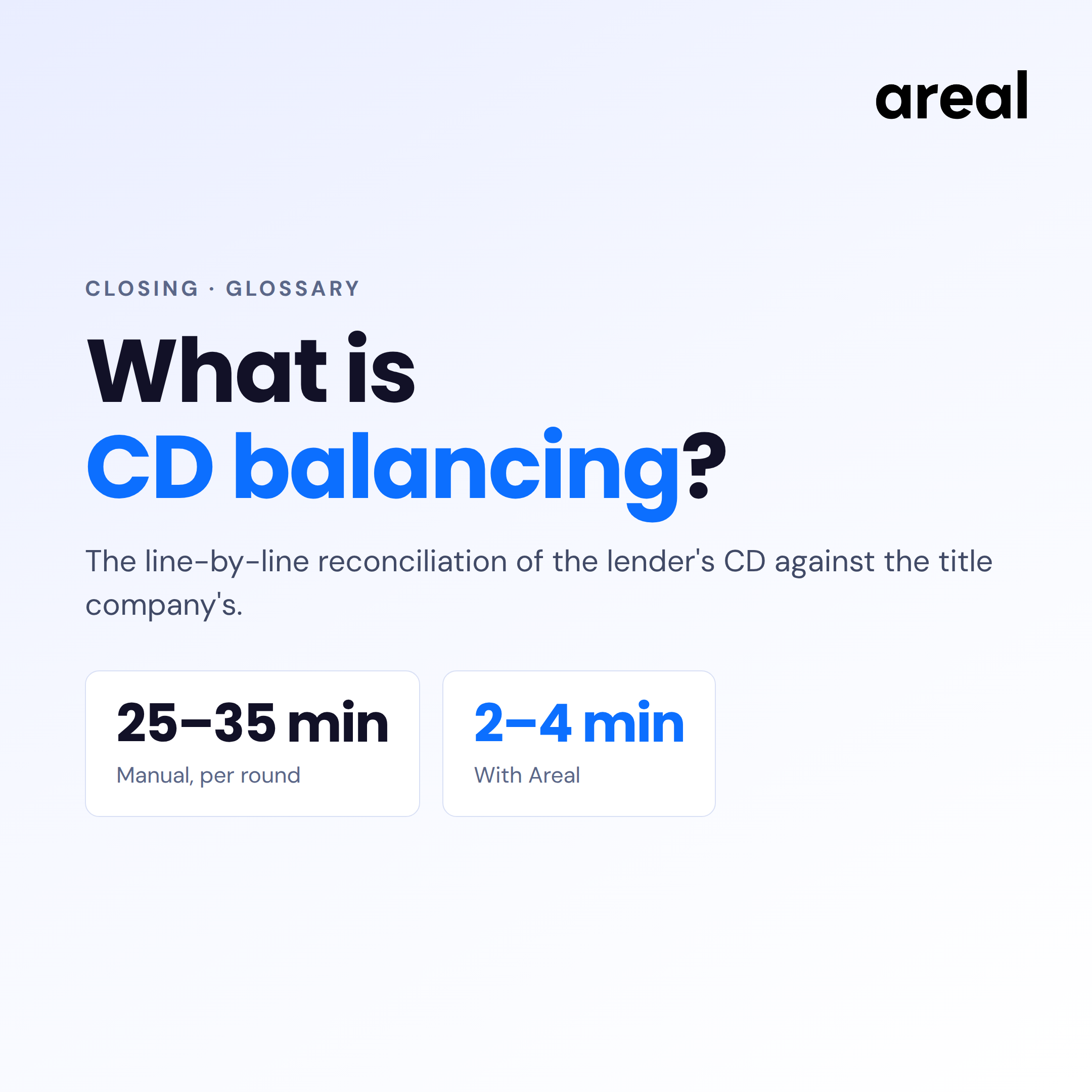
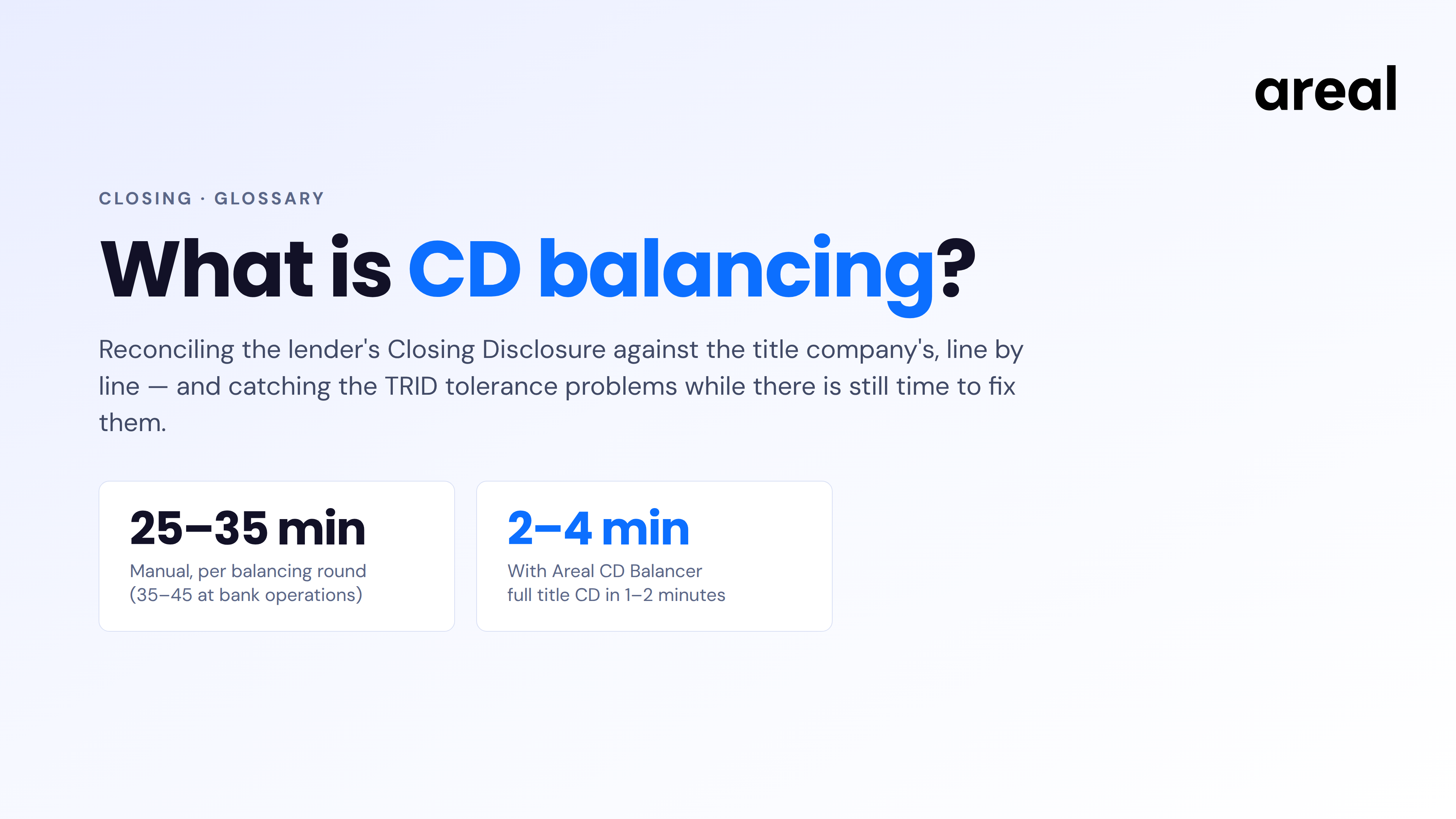
Manually, a single round of CD balancing takes 25 to 35 minutes at a typical independent mortgage bank, and 35 to 45 minutes at a bank closing operation where compliance review runs in the same step. Most files need three to four rounds, so a full loan absorbs up to two hours of closer time.
With Areal CD Balancer, a round takes 2 to 4 minutes, and a full title CD is reconciled against the lender's CD in 1 to 2 minutes. The recovered time is up to two hours per loan, and it is recovered in the place it hurts most, the end of the month, when the closing calendar is densest.
[EDITOR: replace this paragraph with an HTML Embed element containing cd_balancing_manual_vs_areal_table.html]
Earlier Areal material, and several third-party articles that still circulate, quoted a 45 to 65 minute manual baseline and described reconciliation finishing in under a minute. Both figures are retired. The current, measured figures are the ones above: 25 to 35 minutes per manual round, 2 to 4 minutes per round with Areal, and 1 to 2 minutes for a full title CD reconciliation. Where a published source still shows the older numbers, the numbers on this page supersede them.
Speed is the supporting argument, not the point. The point is that every line is checked on every loan, every tolerance decision is categorised the same way by the same logic, and the whole comparison is logged. A closer who is fast but inconsistent still produces cures. A team that balances identically on every file produces an audit trail that survives the exam.
Areal CD Balancer is purpose-built software that automates CD balancing. It reads the title company's Closing Disclosure or settlement statement, maps every title fee line automatically to the matching fee in the lender's LOS, categorises each difference into its TRID tolerance bucket, logs the result, and pushes balanced fees back into the LOS. It runs natively inside ICE Encompass, Byte LOS and MeridianLink, so the closer stays in the system they already work in and there is no LOS migration.
Closers looking at this problem generally evaluate four different categories of tool, and it is worth being clear about what each one does, because they are not substitutes:
The practical test when evaluating any of them is narrow. Does it read the title company's document as it actually arrives, usually as a scan? Does it map fee lines automatically rather than asking a closer to map them once per file? Does it categorise TRID tolerance buckets, or just show differences? Does it write back into the LOS, or produce a report someone then rekeys? And does it leave a log an auditor can follow?
Areal CD Balancer is used in production by top-tier lenders including all Guaranteed Rate Companies and Canopy Mortgage. It is one product inside Areal Copilot Agent, the mortgage-specific agentic AI platform that also runs borrower onboarding, funding review and post-closing review. If you are still working out what the form itself contains, start with the Closing Disclosure explained line by line. For the wider category context, see what mortgage automation covers in 2026.
It means at least one line item on the lender's Closing Disclosure does not match the corresponding line on the title company's CD or settlement statement. The file cannot proceed to funding until the difference is either corrected on one side or explained and documented.
A TRID tolerance is the limit on how much a given fee may increase between the Loan Estimate and the Closing Disclosure. Zero-tolerance fees, such as lender origination charges and fees for services the borrower could not shop for, cannot increase at all. A 10% cumulative tolerance applies to recording fees and to services from a lender-provided written list that the borrower did shop for. Other items, including prepaid interest and services the borrower shopped for independently, have no tolerance limit. Exceeding a tolerance without a valid changed-circumstance reason requires the lender to cure the difference.
Both prepare a Closing Disclosure, but the lender is responsible for the accuracy of the borrower's CD and for TRID compliance. In practice the lender's closer drives the reconciliation and the settlement agent responds.
Yes. Areal CD Balancer has a native ICE Encompass integration, and native integrations with Byte LOS and MeridianLink. The closer works inside the LOS they already use; there is no migration and no second system to learn.
Three to four rounds is normal. Purchase transactions with seller credits, multiple payoffs or prorated items commonly take more.
The comparison, the fee mapping, the tolerance categorisation and the write-back can be automated. The closer still owns the judgment calls, whether a changed circumstance is valid, how to handle an unusual seller credit, and the final sign-off before the file funds. The work that goes away is the reading and the retyping, not the decision.
CD balancing happens before consummation and is a control on the document the borrower signs. A post-closing audit happens after funding and checks the completed file against investor requirements. Different step, different checklist, different team.
Yes. Areal CD Balancer for Title is the same core product adapted to title production workflows, and it can auto-generate title fees from the lender's initial CD, which is a title-side use case with no mortgage equivalent.
We'll show you which workflows to automate first — and the exact ROI for your volume.
Book a Demo →