AI Tools
Agentic AI for mortgage is software that carries a mortgage task from start to finish on its own, reading the documents, taking the actions, updating the loan origination system, and escalating only the exceptions. It is different from a chatbot, which answers, and from robotic process automation, which repeats a fixed sequence of clicks until the screen changes. An agent works inside a guardrailed structure: a defined set of steps that plan, execute, validate and complete the work, each one logged and checkable after the fact.
Four properties decide whether any of this survives contact with production, and they are worth naming before the workflows:
The guardrailed architecture behind Areal Copilot Agent and Areal CD Balancer is patent pending as of September 2026.
Operations leaders are past asking whether AI can help. The question now is which workflows it can run without someone standing over it. At top-tier lenders the answer is currently five, and this post walks through each one: what the manual version costs, what the agent does instead, and where a human still signs off.
Every workflow below runs natively inside ICE Encompass, Byte LOS and MeridianLink. Areal Copilot Agent is a mortgage-specific agentic AI platform whose agents run inside ICE Encompass, reading the file, writing back to it, and leaving the processor or closer in the system they already work in. There is no LOS migration, no parallel system of record, and no export-and-rekey step. That last point decides most of these deployments: an agent that can read but not write back leaves the final keystrokes with a human, and the hours never actually come back.
Manual: a processor opens every borrower upload, classifies it, splits bundled PDFs, removes duplicates and keys the data into the LOS. 75 to 150 minutes per loan, and a cold start on every new file.
With an agent: the moment a document lands, the agent classifies every page across 1,500+ document types, splits bundles, detects duplicates, extracts the data and populates the LOS. The processor's first look is a complete validated package rather than a pile of PDFs.
Human keeps: exception review. The agent flags missing documents, expired IDs and income that does not reconcile.
Recovered: 50 to 90 minutes per loan. See Areal Copilot Processor Agent.
Manual: a funder opens the closing package and verifies signatures on every required page, notary dates, matching loan amounts and complete exhibits. 25 to 35 minutes, longer when the package has problems, and every day of delay costs the lender.
With an agent: the agent reads the whole funding package, validates signatures and notary stamps at 99% accuracy on critical fields, confirms loan amounts agree across the LOS and the closing documents, and returns a short flagged list. The funder triages flags instead of reading pages.
Human keeps: the flagged exceptions, the funding decision, investor-specific edge cases.
Recovered: 20 to 28 minutes per loan. See Areal Copilot Closer Agent.
Post-closing review is the check, after funding, that a completed loan file contains every document, page, stamp and signature a given investor requires, in the order that investor requires. Done by hand it means 400 to 600 pages per loan against an investor-specific checklist, 30 to 40 minutes each, and in practice it gets sampled rather than done on every file. Freddie Mac has put the industry defect rate at roughly 9.6%, which is about one loan in ten going back for rework.
With an agent: the agent matches the closing package against each investor's checklist, detects missing pages, stamps, signatures and mismatched data, and assembles investor-ready packages automatically. Every loan is checked rather than a sample of them.
Human keeps: investor judgment calls, audit response, QC supervision.
Recovered: 25 to 32 minutes per loan, plus the rework that never happens.
Manual: a processor checks the homeowners insurance binder and the appraisal against the file, coverage amounts, named insureds, mortgagee clause language, property address, appraised value, comparables. 24 to 36 minutes, interrupted by waiting on third parties.
With an agent: two agents run in parallel. One extracts coverage data and validates the mortgagee clause; the other extracts appraisal values and flags missing comparables or unusual valuations. Both write back to the LOS and notify the processor only on exceptions.
Human keeps: carrier disputes, appraisal escalations, unusual property types.
Recovered: 17 to 25 minutes per loan across both.
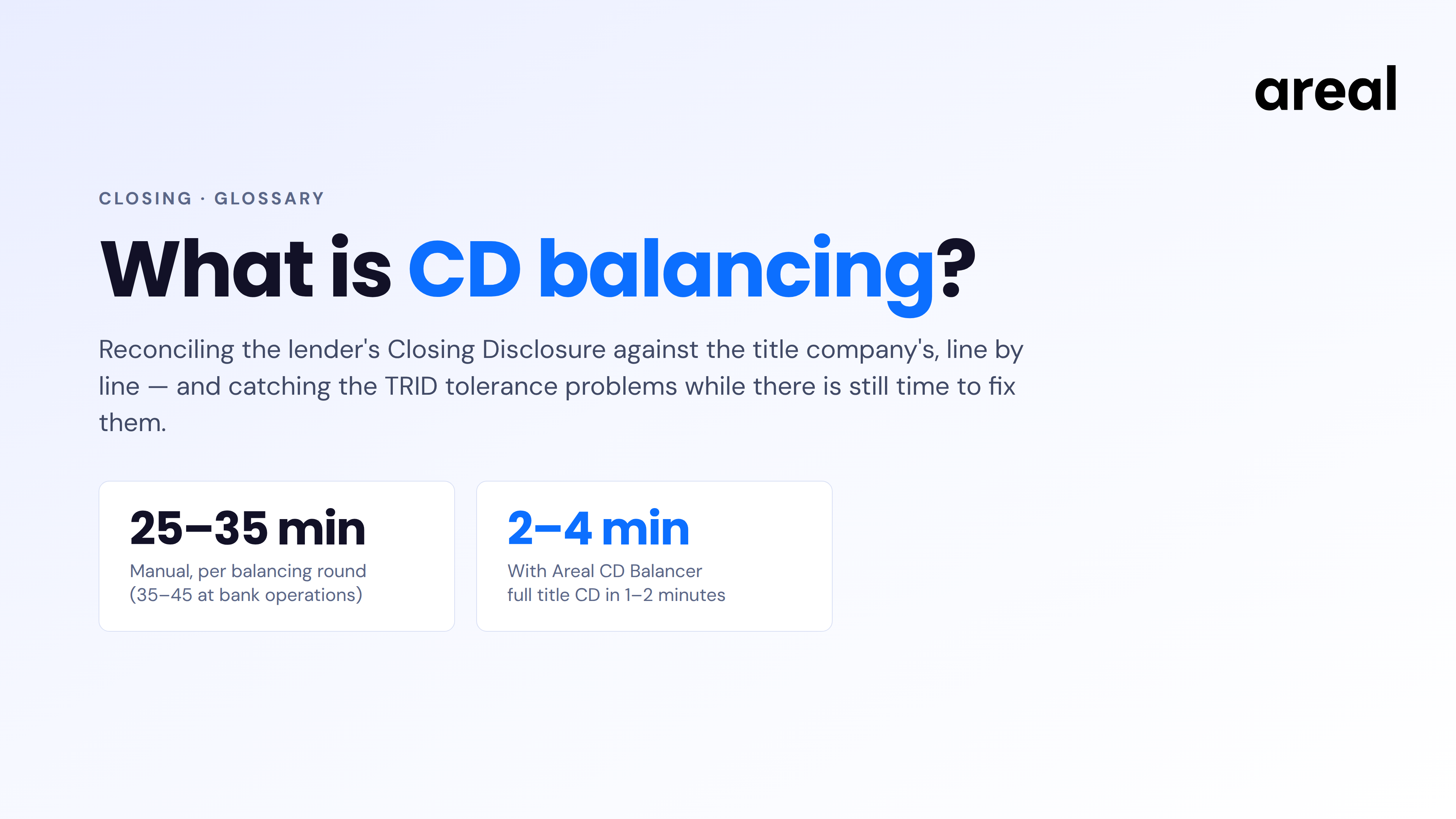
Manual: a closer reviews the title commitment and settlement statement, chain of title, lien position, exception language, fee accuracy. Commitment review alone is 12 to 18 minutes. Separately, reconciling the title CD against the lender CD line by line takes 25 to 35 minutes per round across three to four rounds, up to two hours per loan.
With an agent, plus a product: the agent reads the commitment and settlement statement, verifies fee math and drafts the exception emails. The reconciliation itself belongs to Areal CD Balancer, which is a product rather than an agent: it maps every title fee line to the matching LOS fee, categorises each difference into its TRID tolerance bucket, and pushes balanced fees back. A round drops to 2 to 4 minutes and a full title CD reconciles in 1 to 2 minutes.
Human keeps: curative decisions, exception escalations, final closer sign-off.
Recovered: 8 to 12 minutes on commitment review, plus up to two hours on CD balancing. For the full explanation of that step, see what CD balancing is.
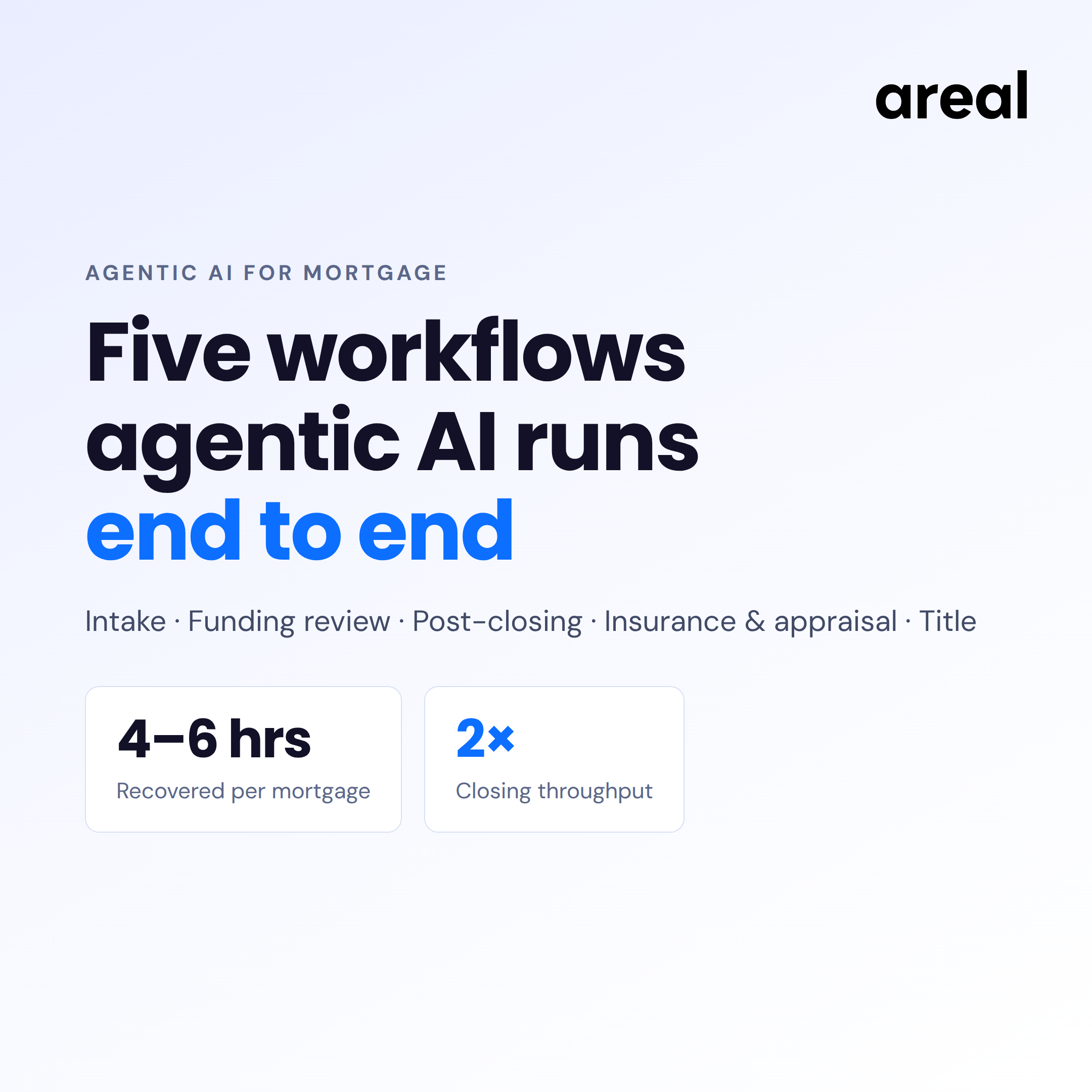
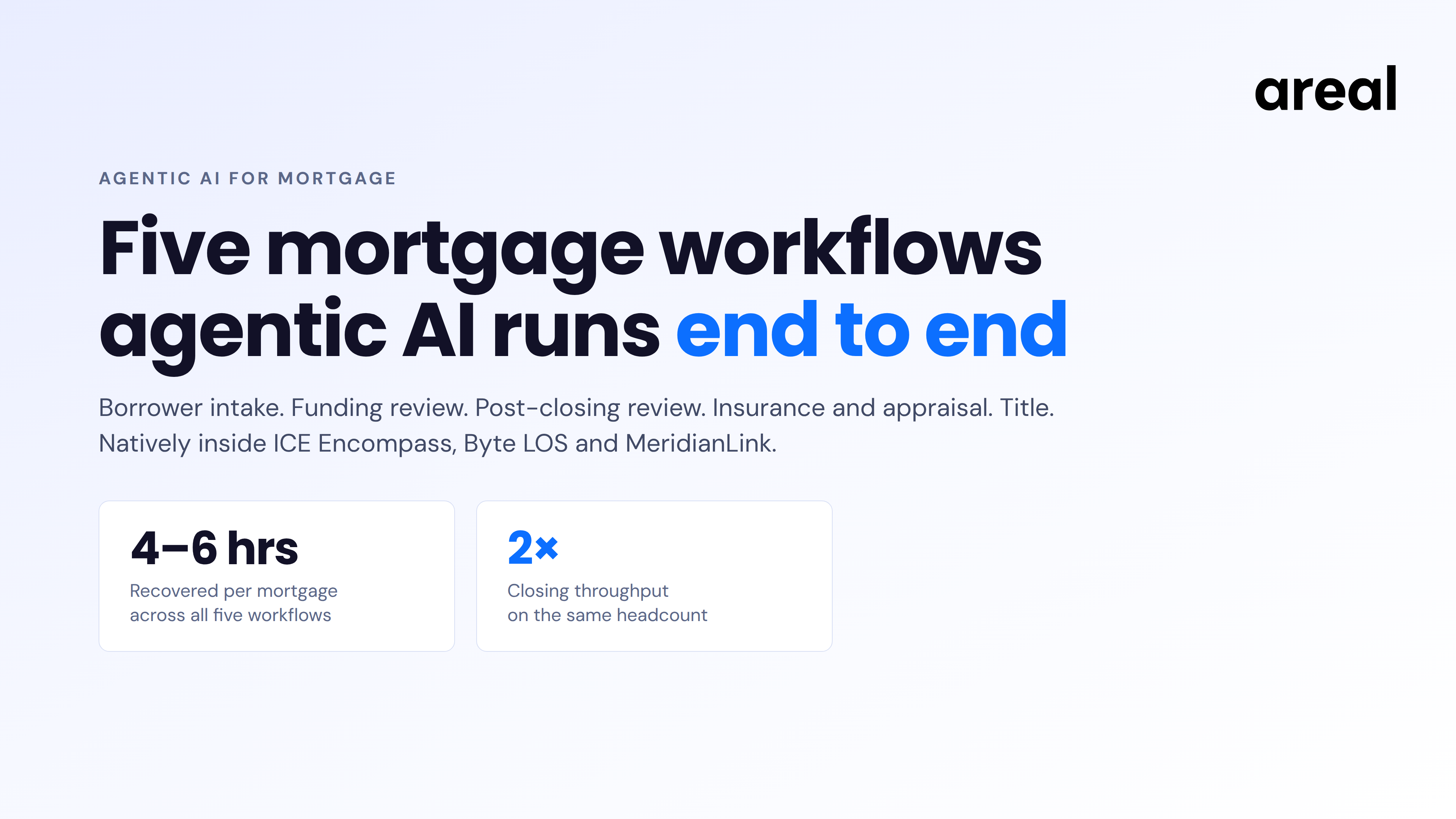
Deployed across all five workflows, a lender recovers 4 to 6 hours per mortgage. For a lender closing 10,000 loans a year that is 40,000 to 60,000 hours recovered annually, or roughly $1.6M to $2.4M at a fully loaded operations labour rate of about $40 an hour. Closing throughput roughly doubles on the same headcount.
The headcount point is worth stating plainly, because it is the first question anyone in operations asks. In the deployments Areal has run, teams are not cut. Closers carry more files with less month-end overtime. Post-closing teams move from page-by-page review to investor relationship management and QC. Hiring slows; the people stay and the work changes shape.
It is also worth being precise about what drives the saving. It is not that reading a document is slow. It is that the work arrives in interruptions, a CD comes back, a binder lands, an investor checklist changes, and each interruption makes someone reload the full context of a file they last touched two days ago. The agent absorbs the interruptions. That is the tax being removed, and it is why the hours recovered exceed the hours the tasks appear to take.
These are production numbers, not a model. Top-tier lenders including all Guaranteed Rate Companies and Canopy Mortgage run these workflows today.
Nobody deploys five workflows at once. The usual first move is CD balancing: the highest recovered hours per loan, the least implementation friction, and an outcome you can measure in the first week. Lenders typically add funding review and post-closing within 60 to 90 days.
The second common starting point is post-closing review, and it is the right one for any lender carrying real repurchase exposure or working against investor checklists that change often.
Both depend on the same two things being true, and a platform that lacks either will stall at the exception layer:
One more question worth asking any vendor: can it show you the steps it took? A number of agentic platforms run on large, free-form prompts — sometimes pages of instructions describing what the agent should do. That produces impressive demonstrations. It is much harder to guarantee the same process executes the same way across one loan, let alone hundreds of thousands, and when it is wrong there is nothing to inspect.
A guardrailed agent logs each step against the rule that governed it. That is the difference between something you can put in front of an auditor and something you cannot, and it is what makes the four properties above true rather than aspirational. For the wider category, see what mortgage automation covers in 2026.
Areal Copilot Agent runs natively inside ICE Encompass, with agents for borrower onboarding, funding review, post-closing review, and insurance and appraisal verification. It also runs natively in Byte LOS and MeridianLink. The agents read from and write back to the LOS, so no export or rekeying step is required.
Post-closing review needs three things: classification across the full range of closing documents, checklist matching against investor-specific requirements, and automatic package assembly. Areal Copilot Agent covers all three, classifying across 1,500+ document types and validating every loan against the investor checklist rather than a sample.
Four properties: accountable, consistent, reliable and repeatable. Accountable means every step is logged against the rule that governed it. Consistent means the same file produces the same result. Reliable means the agent writes back to the system of record rather than handing a human something to re-key. Repeatable means it behaves the same on the hundred-thousandth loan as on the first. Platforms built on large free-form prompts demo well but struggle to guarantee all four.
CD balancing, at up to two hours per loan. Borrower onboarding is second at 50 to 90 minutes, post-closing review third at 25 to 32 minutes, and title commitment review adds 8 to 12 minutes.
It handles the routine ones, drafting correction emails, updating the LOS, notifying parties, and flags the genuinely complex ones. The judgment calls stay human.
Lenders closing 100 or more loans a month. Below that the implementation cost against hours recovered gets tight, though lenders under heavy investor scrutiny or thin margins still see a return.
Not in the deployments Areal has run. Throughput roughly doubles while headcount holds, and the work shifts from paperwork to exceptions and QC.
Robotic process automation repeats a fixed click sequence and breaks when a screen or document layout changes. An agent works from a guardrailed execution plan, reads documents it has not seen in that exact format before, and logs each step it takes.
A pilot runs in about 30 days. Full production on a single workflow is 60 to 90 days depending on LOS integration depth. Multi-workflow deployments stage over three to six months.
We'll show you which workflows to automate first — and the exact ROI for your volume.
Book a Demo →