Non-QM lending is growing. Rising interest rates, tighter agency guidelines, and an expanding population of self-employed borrowers, real estate investors, and gig workers have pushed more loan volume into the non-qualified mortgage space. That growth is good for business — but it comes with an operational cost most lenders underestimate.
Non-QM loans require more documents than conventional loans. More document types, more complexity per file, more manual judgment calls from your processing team. And when your processors are spending three to four hours per file on document review alone, scaling non-QM volume means scaling headcount. That math stops working quickly.
Conventional loans follow a predictable document checklist: W-2s, pay stubs, tax returns, bank statements, and a few supporting items. The income is salaried, the docs are standardized, and most processors can work through a file with reasonable speed.
Non-QM breaks that pattern at almost every step.
A self-employed borrower might submit 24 months of bank statements, a year-to-date profit and loss statement, two years of personal and business tax returns, and a CPA letter — instead of a single W-2. A real estate investor applying for a DSCR loan brings a rent schedule, lease agreements, an appraisal with rental income analysis, and property documentation that varies by state and property type. An asset depletion borrower submits brokerage statements, retirement account summaries, and a calculation methodology that your processor needs to verify manually against investor guidelines.
Each of these document packages is different. The documents don't follow a standard layout. The data your processor needs to extract — monthly deposits, qualifying income, cash reserves, lease terms — is scattered across pages that were never designed to be machine-readable.
The result: non-QM files take two to three times longer to process than conventional loans, even when the loan amount and complexity are comparable.

Most lenders underestimate how much time is lost in non-QM document intake and review. Here's where it goes:
Document classification and sorting. A non-QM file might include 40 to 80 pages from a dozen different document categories. A processor opening a new file spends the first 15 to 20 minutes just identifying, sorting, and labeling what was submitted. Duplicate pages, bundled PDFs, and incorrectly named files add more time.
Data extraction and verification. Pulling qualifying income from 24 months of bank statements isn't a lookup — it requires reading, calculating, and cross-referencing. The same is true for DSCR calculations, asset schedules, and income verification from P&Ls that don't follow GAAP formatting.
Condition clearing. Non-QM investors have specific, varied guidelines. A condition that clears for one non-QM product may not satisfy another. Processors spend significant time re-reading investor matrices and matching conditions against documents manually.
Error correction. When document verification is manual, errors surface late — often at closing or post-closing, when they're expensive to fix. A missed income calculation caught after funding creates rework that touches processing, closing, and compliance.
The challenge with non-QM document automation isn't the AI itself — it's whether the AI has been trained on the full range of document types that non-QM loans actually require.
Generic document processing tools struggle here. A tool trained primarily on W-2s and 1040s will produce unreliable results on a bank statement with 18 months of deposits, or a foreign national borrower's translated income documentation, or a DSCR rental analysis with property-level cash flow detail.
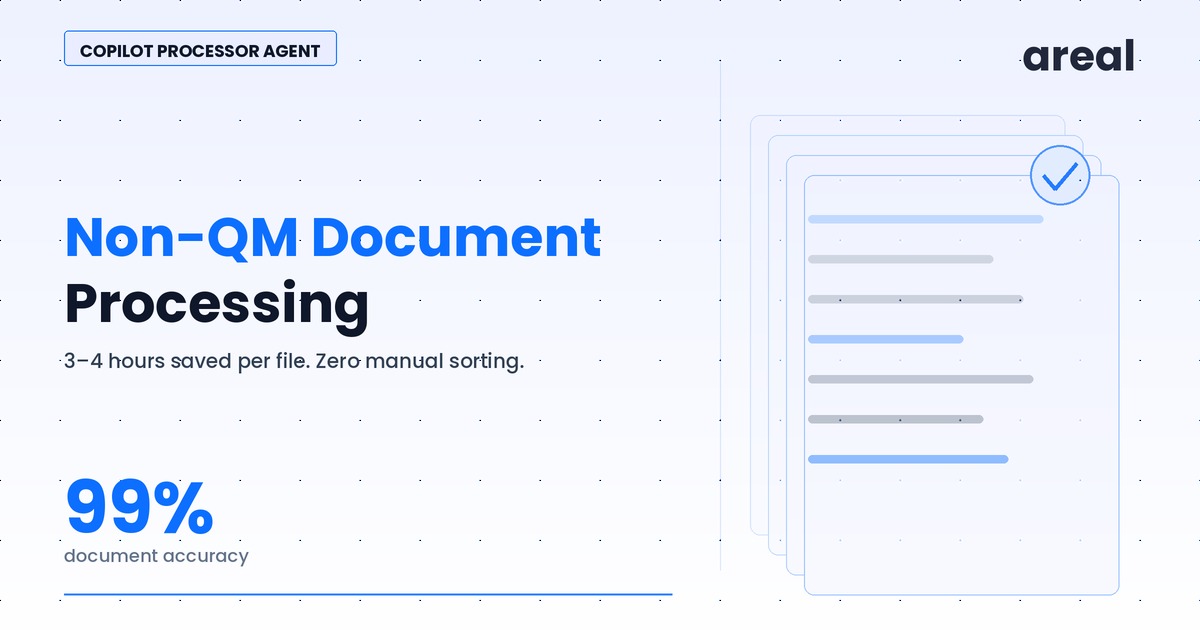
Areal's Copilot Processor Agent was built specifically for mortgage — and for non-QM mortgage in particular. It handles 1,500+ document types, including the full range of alternative income documents that non-QM programs require. Classification accuracy runs at 99%, which means processors aren't spending time correcting mislabeled or misrouted documents.
The practical impact:
• Classification is automatic. Documents are identified, sorted, and routed the moment they arrive — no manual sorting required.
• Data extraction is structured. Income, assets, property data, and borrower information are pulled into structured fields, not left as raw text for a processor to transcribe.
• Condition matching is faster. When investor guidelines are mapped into the system, the AI can flag whether submitted documentation satisfies specific conditions — reducing the back-and-forth between processing and the investor.
• Errors are caught earlier. Discrepancies between documents — mismatched borrower names, inconsistent income figures, missing signatures — are flagged before the file reaches closing.
A non-QM processor handling bank statement loans typically spends 2 to 3 hours per file on document review alone. With AI document processing, that drops substantially — most of the classification and extraction work happens automatically, and the processor shifts from doing the work to reviewing flagged exceptions.
For a team processing 20 non-QM files per month, that's a meaningful reduction in per-file labor cost. For a team processing 100 or more, it's the difference between keeping up with volume and falling behind.
The accuracy improvement matters too. Non-QM loans have higher stakes at post-closing — investors scrutinize these files more carefully, and defects are more expensive to cure. Catching document issues at intake, rather than after funding, reduces the cost and frequency of those cures.
Non-QM lending carries compliance risk that doesn't exist in the same form for agency loans. ATR (Ability to Repay) documentation requirements, state-specific disclosures, and investor-specific guidelines all create a compliance surface that manual review struggles to cover consistently.
Automated document processing reduces that risk in two ways. First, it creates a consistent, auditable record of what was reviewed and when — every document classification decision is logged, not left to processor memory. Second, it applies the same rules every time, without the variation that comes from reviewer fatigue, training gaps, or inconsistent process interpretation.
For lenders building non-QM volume, compliance consistency at scale isn't optional. It's what allows the program to grow without a proportional increase in compliance risk.
Bottom line: Non-QM document processing is harder than agency processing, and manual review was never designed to handle it at scale. AI document processing built specifically for mortgage — not adapted from general-purpose tools — is what makes non-QM volume sustainable.
We'll show you which workflows to automate first — and the exact ROI for your volume.
Book a Demo →