Mortgage AI & Automation
Best AI Mortgage Automation Software: What Lenders Should Look for in 2026
AI mortgage automation software can reduce manual document processing, streamline loan workflows, support closing operations, and improve operational efficiency. This guide explains the capabilities lenders should evaluate before choosing a platform.
What Is the Best AI Mortgage Automation Software?
The best AI mortgage automation software depends on a lender's operational requirements. Leading capabilities to evaluate include intelligent document processing, automated loan workflows, agentic AI, loan origination system integration, closing automation, security, and measurable return on investment.
Platforms that connect document intelligence with operational execution can help lenders reduce manual work across multiple stages of the mortgage lifecycle. Areal AI is one example of a mortgage-focused platform offering document intelligence and agentic workflow automation.
Why Mortgage Lenders Are Investing in AI Automation
Mortgage lenders face persistent pressure to control operating expenses while managing complex documentation, regulatory requirements, and borrower expectations.
Traditional mortgage operations often depend on employees manually reviewing documents, entering information, identifying missing items, and coordinating activities across multiple technology systems.
Artificial intelligence can reduce many of these repetitive activities.
Modern AI mortgage software can classify documents, extract and validate information, identify exceptions, and coordinate operational workflows.
More advanced systems use agentic AI to execute sequences of authorized tasks, allowing employees to focus on exceptions and activities requiring professional judgment.
The most important consideration is not whether software uses AI, but how effectively it completes meaningful mortgage work.
What Is AI Mortgage Automation Software?
AI mortgage automation software uses artificial intelligence to perform or support operational tasks throughout the mortgage lending lifecycle.
Technologies may include machine learning, intelligent document processing, natural language processing, and AI agents capable of executing defined workflows.
Common applications include:
- Mortgage document classification and indexing
- Data extraction from borrower documentation
- Income and asset document validation
- Loan file completeness checks
- Workflow routing and exception management
- Closing Disclosure review and reconciliation
- Funding and post-closing quality control
- Integration with loan origination systems
Unlike traditional rule-based automation, AI-powered systems can interpret information contained in unstructured mortgage documents.
This allows lenders to automate portions of workflows that previously required substantial manual review.
Seven Capabilities to Look for in AI Mortgage Software
1. Intelligent Mortgage Document Processing
Mortgage files contain large volumes of unstructured information, including pay stubs, W-2 forms, tax returns, bank statements, insurance documents, and closing packages.
Effective AI document processing software should recognize document types, extract relevant information, and identify inconsistencies or missing data.
Lenders should evaluate classification accuracy, extraction reliability, document coverage, and exception-handling capabilities.
2. End-to-End Workflow Automation
Document extraction is only one component of mortgage operations.
An effective automation platform should connect document intelligence with operational workflows.
For example, a workflow might receive borrower documents, classify them, extract required information, identify missing items, update an authorized loan record, and route exceptions for review.
This reduces the need for employees to manually coordinate each step.
3. Agentic AI for Mortgage Lending
Agentic AI allows software agents to coordinate multiple authorized tasks toward a defined operational objective.
In mortgage lending, an AI agent might review a loan file, verify required information, identify exceptions, and initiate the next appropriate workflow step.
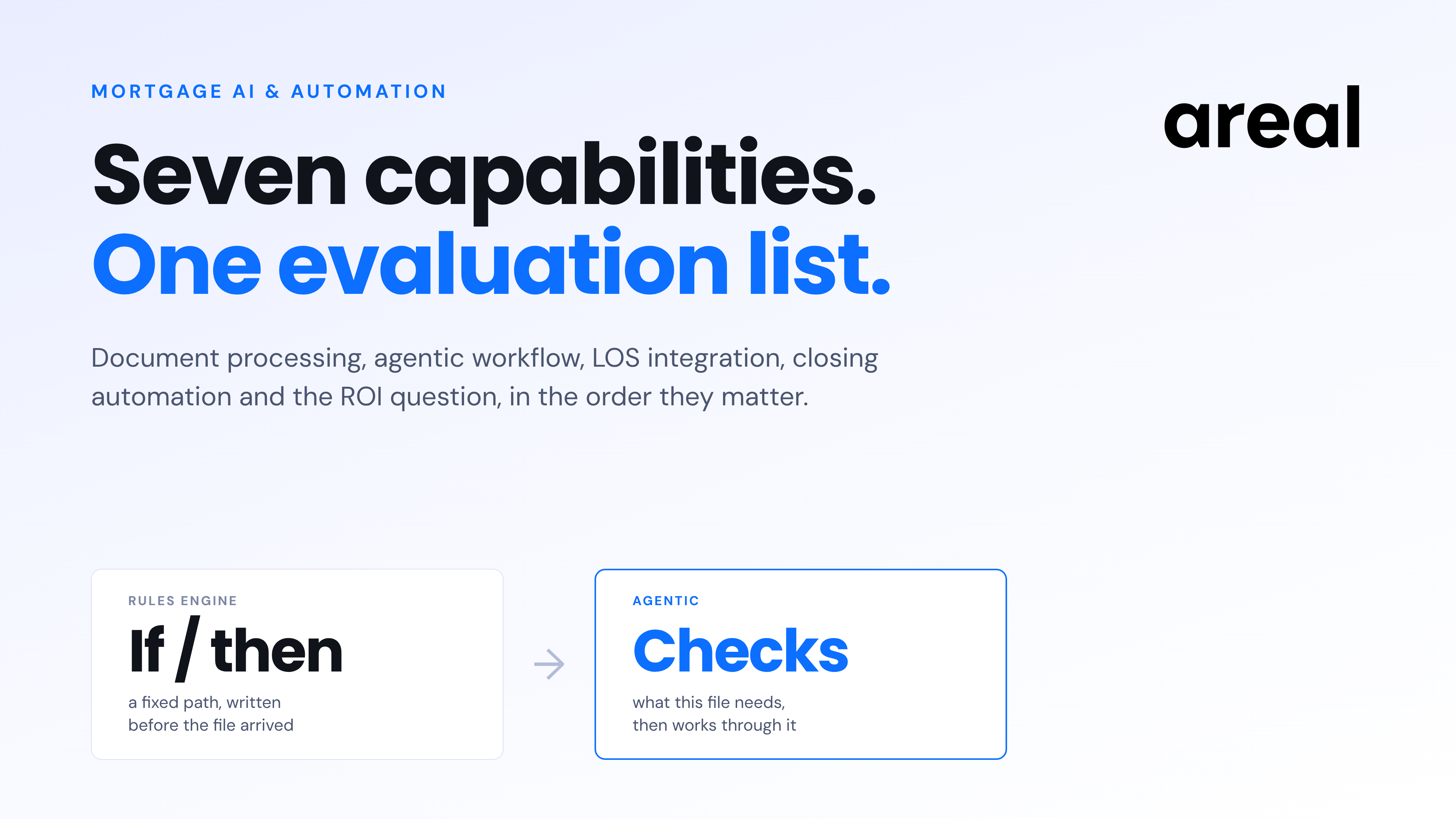
Traditional automation generally follows predefined instructions. Agentic systems can interpret context and coordinate actions within established boundaries.
Lenders should require clear permissions, audit trails, human oversight, and appropriate exception handling.
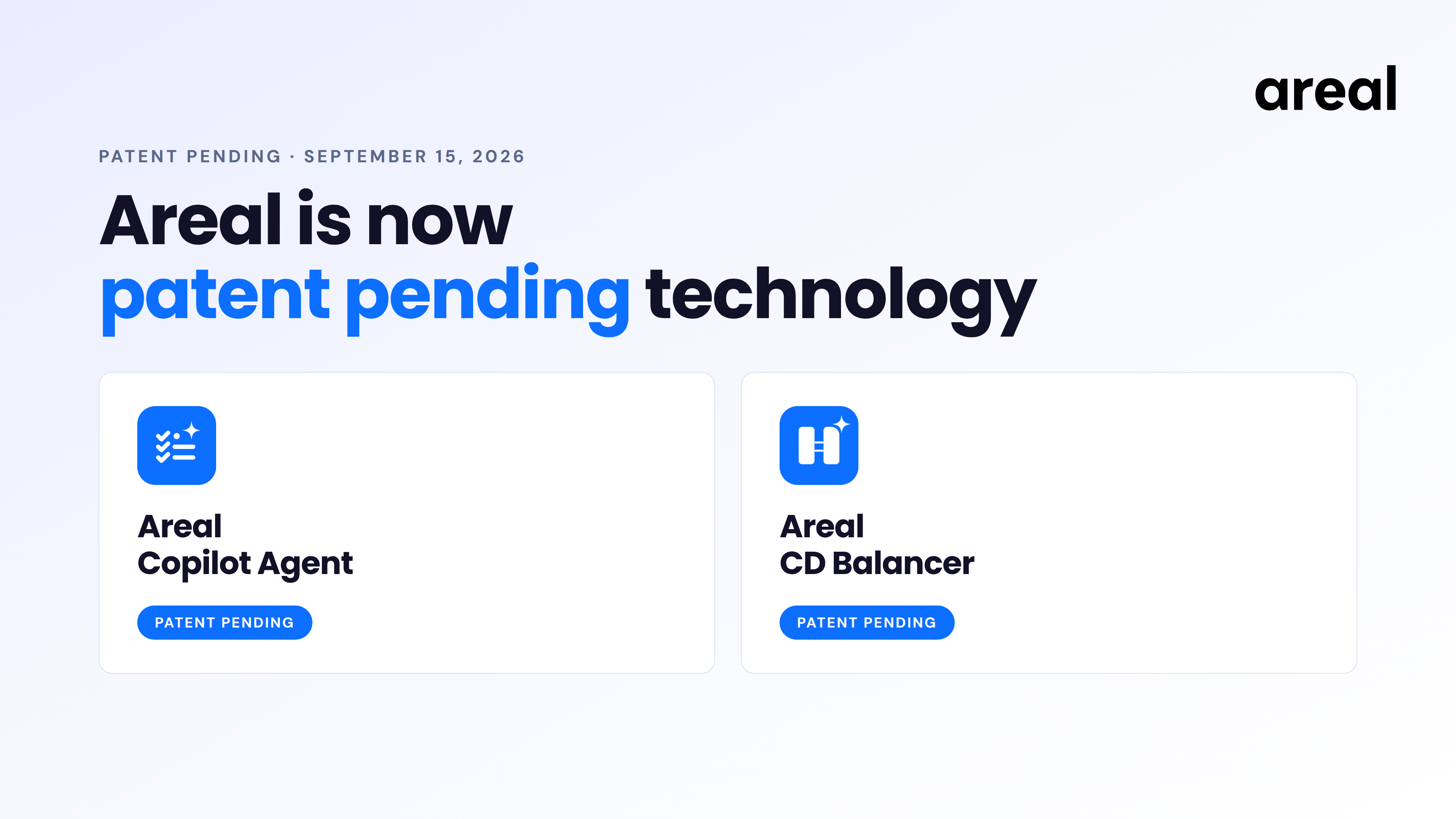
Learn how Areal Copilot Agent supports agentic automation for mortgage operations.
4. Loan Origination System Integration
Mortgage automation should work with the systems lenders already use.
Compatibility with loan origination systems such as ICE Encompass, MeridianLink, and Byte can be an important consideration.
Lenders should verify whether a platform can read authorized loan information, write approved updates, synchronize data, and maintain access controls.
Integration reduces the need to transfer information manually between disconnected applications.
5. Closing and Post-Closing Automation
Mortgage automation opportunities extend beyond origination and processing.
Closing operations require document comparison, fee reconciliation, disclosure review, and coordination among multiple parties.
AI-powered closing technology can help identify discrepancies and automate portions of Closing Disclosure balancing.
For example, Areal CD Balancer supports automated fee comparison, discrepancy identification, and reconciliation workflows.
Post-closing automation can also support file completeness checks, document organization, and exception identification.
6. Security, Compliance, and Auditability
Mortgage lenders manage sensitive borrower financial and personal information.
AI software should be evaluated for data security, user permissions, audit logging, information handling practices, and compliance support.
Lenders should understand how automated actions are recorded, reviewed, and escalated when exceptions occur.
AI technology does not eliminate a lender's regulatory responsibilities.
7. Measurable Return on Investment
The strongest mortgage automation investments produce measurable operational improvements.
Useful performance indicators include:
- Manual processing time per loan
- Document review turnaround time
- Employee hours spent on repetitive tasks
- Exception and rework rates
- Closing and funding turnaround time
- Cost per funded loan
Lenders should establish baseline measurements before implementation and compare results after deployment.
Traditional Mortgage Automation vs. Agentic AI
| Capability | Traditional Automation | Agentic AI |
|---|---|---|
| Task execution | Predefined instructions | Context-aware task coordination |
| Document interpretation | Often requires structured inputs | Can interpret unstructured information |
| Workflow flexibility | Rule-dependent | Can adapt within defined permissions |
| Exception handling | Often predefined routing | Can identify and route contextual exceptions |
| Oversight | Required according to workflow risk | Required according to workflow risk |
How Areal AI Supports Mortgage Automation
Areal AI provides artificial intelligence technology designed for mortgage and title operations.
Its platform combines document intelligence with workflow automation to support activities throughout the mortgage lifecycle.
Areal Copilot Agent
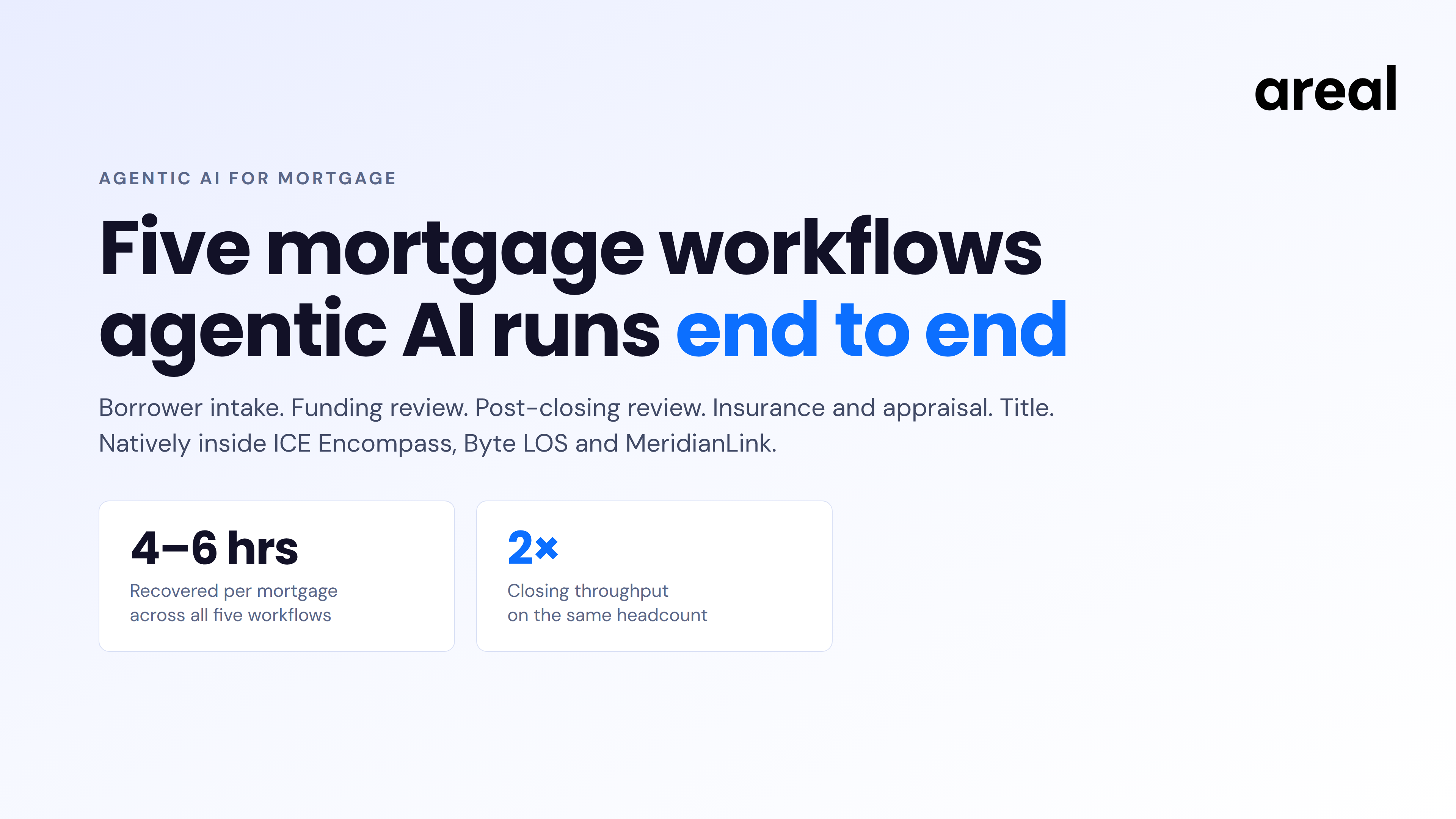
Areal Copilot Agent supports agentic mortgage workflows, including document review, loan processing, closing support, funding review, and post-closing activities.
The platform is designed to work with existing loan origination systems while providing controlled workflow execution and auditability.
Areal CD Balancer
Areal CD Balancer automates portions of Closing Disclosure comparison and fee reconciliation.
The software identifies fee discrepancies, supports tolerance review, and helps closing teams focus on exceptions rather than manually comparing every line item.
Mortgage Processing Automation
Areal also provides AI-powered processing capabilities for document classification, borrower onboarding, and income and asset document validation.
Explore Areal Copilot Agent for Processing to learn more about these workflows.
How to Choose the Right AI Mortgage Automation Platform
Before selecting a platform, lenders should identify the operational problems they want to solve.
- Identify workflows consuming the most employee time.
- Determine which tasks can be automated while maintaining compliance and quality.
- Verify compatibility with existing loan origination systems.
- Evaluate accuracy, exception handling, and auditability.
- Establish measurable performance goals and test the solution using representative loan files.
A limited pilot can help validate operational performance before a broader implementation.
Frequently Asked Questions About AI Mortgage Software
What is the best AI mortgage automation software?
The best platform depends on the lender's operational requirements. Important factors include document processing accuracy, workflow automation, LOS integration, security, and measurable efficiency improvements.
Can AI automate mortgage loan processing?
Yes. AI can automate or assist with document classification, data extraction, completeness checks, workflow routing, and exception identification. Human oversight remains important for complex and regulated decisions.
What is agentic AI in mortgage lending?
Agentic AI uses software agents to coordinate and execute authorized tasks toward defined operational goals. Applications include document review, workflow management, closing support, and exception handling.
Can AI mortgage software integrate with Encompass?
Yes. Some mortgage AI platforms support integration with ICE Encompass. Lenders should verify the specific workflows, permissions, and data synchronization capabilities supported by each solution.
How can AI reduce mortgage cost per loan?
AI can reduce repetitive manual work, accelerate document processing, improve workflow coordination, and identify errors earlier. Actual savings depend on loan volume, implementation, staffing, and existing operating processes.
The Future of AI Mortgage Automation
AI mortgage automation is evolving beyond individual task automation toward more connected, intelligent operational workflows.
Lenders evaluating technology in 2026 should prioritize solutions that combine document intelligence, workflow execution, system integration, and measurable performance.
The objective is not simply to introduce artificial intelligence into mortgage operations. It is to complete more work accurately, reduce unnecessary manual intervention, and create a more efficient lending process.
Learn how Areal AI supports mortgage automation. Visit Areal.ai to explore its technology and solutions.