AI Tools
Intelligent document processing (IDP) is the use of artificial intelligence to classify documents, extract relevant information, validate data, and organize information for downstream workflows. In mortgage lending, IDP can process documents such as pay stubs, W-2 forms, bank statements, tax returns, insurance records, and closing disclosures.
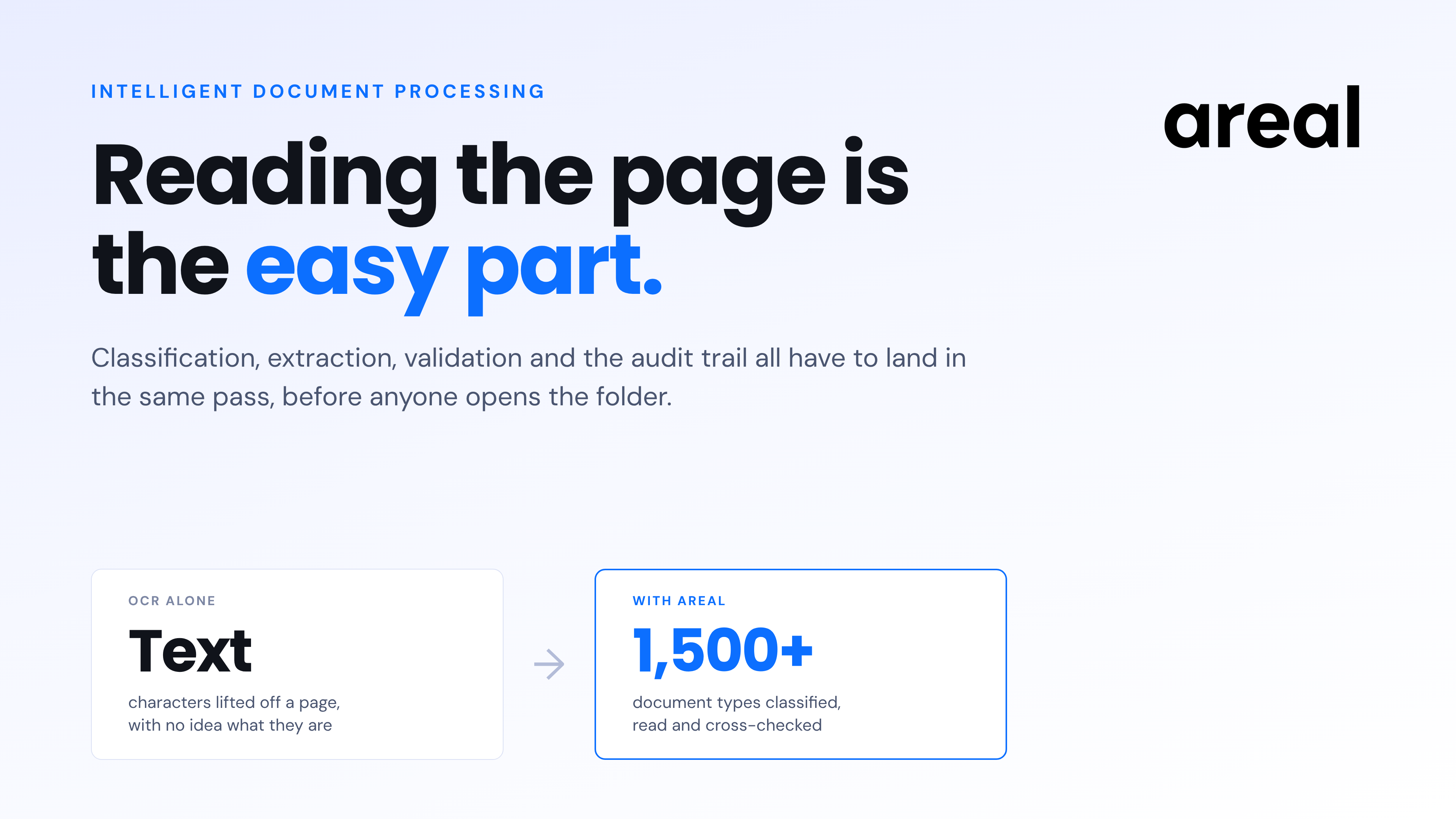
Unlike basic optical character recognition (OCR), which primarily converts document images into machine-readable text, IDP combines text recognition with document understanding, classification, extraction, and validation.
Mortgage-focused platforms such as Areal AI connect document intelligence with workflow automation to help lenders reduce repetitive manual tasks.
Mortgage loan files contain substantial volumes of documentation from borrowers, employers, financial institutions, settlement providers, and other third parties.
These documents frequently arrive in different formats, layouts, and levels of completeness.
Traditional processing often requires employees to manually organize documents, locate information, compare values, and enter data into loan systems.
This creates several operational challenges:
Intelligent document processing helps address these challenges by automating routine document-related activities.
Mortgage IDP systems typically combine several technologies and processing steps.
Documents are received through approved channels, such as a borrower portal, document management system, or connected loan origination platform.
AI identifies document types based on their content, structure, and other recognizable characteristics.
For example, the system may distinguish a W-2 from a pay stub or a bank statement from a tax return.
The software extracts relevant information from supported documents.
Examples include borrower names, employer information, income figures, account balances, and document dates.
Extracted information can be evaluated against defined requirements and other available data.
Potential inconsistencies, missing values, or uncertain results may be flagged for additional review.
Validated information can be routed to connected systems or used to initiate authorized workflow steps.
Documents or data requiring additional judgment are directed to appropriate employees for review.
These steps allow IDP to support broader mortgage workflow automation rather than operating as an isolated extraction tool.
Intelligent document processing can support a wide range of mortgage documentation, depending on the platform's capabilities.
Common mortgage document categories and potential AI processing applications
| Document Type | AI Processing Application |
|---|---|
| Pay stubs | Income data extraction and document review |
| W-2 forms | Employer and wage information extraction |
| Bank statements | Account information and balance extraction |
| Tax returns | Financial information organization |
| Insurance documents | Coverage and policy information review |
| Appraisal reports | Document classification and field extraction |
| Closing Disclosures | Fee and disclosure data extraction |
| Title documents | Document classification and information extraction |
Actual document coverage and extraction accuracy vary by provider and document type.
Optical character recognition and intelligent document processing serve related but different purposes.
Comparison of OCR and intelligent document processing
| Capability | OCR | IDP |
|---|---|---|
| Text recognition | Yes | Yes |
| Document classification | Not typically inherent | Supported |
| Structured data extraction | Requires additional processing | Core capability |
| Contextual interpretation | Limited independently | AI-assisted |
| Data validation | Requires additional tools | Can be integrated |
| Workflow integration | Requires additional systems | Can be integrated |
OCR can be a component of an IDP system, but text recognition alone does not provide the same level of document understanding or workflow functionality.
Automated classification and extraction can reduce time spent sorting documents and manually locating information.
Earlier document organization and validation can help reduce processing bottlenecks and accelerate subsequent tasks.
Standardized extraction and validation procedures can support more consistent handling of borrower information.
Automated checks can help identify missing documents and incomplete information before downstream review.
Reducing repetitive document handling can allow teams to manage larger document volumes without proportional increases in manual effort.
Improved document processing efficiency can contribute to lower operating costs when implemented effectively.
Intelligent document processing provides structured information that can support automated mortgage workflows.
Agentic AI extends this capability by coordinating authorized actions based on available information and defined goals.
For example, an AI agent may:
This combination helps connect document intelligence with operational execution.
Learn more about Areal Copilot Agent and agentic mortgage workflow automation.
Areal AI provides document intelligence and AI-powered workflow automation designed for mortgage and title operations.
Its technology is designed to support document classification, information extraction, and automated operational workflows throughout the mortgage lifecycle.
Areal Copilot Agent for Processing combines document-related capabilities with mortgage processing workflow automation.
The solution is designed to reduce repetitive document review and support the identification and routing of processing exceptions.
Areal Copilot Agent supports agentic workflow execution across mortgage operational activities.
Connecting extracted information with authorized workflow actions can help lenders reduce manual coordination between processing steps.
Lenders should evaluate specific document coverage, supported integrations, accuracy, and workflow configurations when considering implementation.
Mortgage lenders should consider the following factors when evaluating an IDP platform:
A representative pilot can help lenders validate document accuracy, processing performance, and operational compatibility.
Intelligent document processing uses AI to classify documents, extract information, validate data, and support downstream workflows.
OCR converts document images into machine-readable text. IDP extends text recognition with document classification, information extraction, validation, and workflow integration.
Yes. AI can classify supported mortgage documents, extract information, identify missing data, and support automated workflows. Capabilities depend on the software and document type.
Yes. Intelligent document processing can extract relevant information from supported bank statements, pay stubs, and other financial documents. Accuracy and coverage should be validated.
IDP can reduce repetitive manual work and improve document processing efficiency. Actual cost savings depend on loan volume, implementation, and existing operations.
Some IDP platforms integrate with ICE Encompass and other loan origination systems. Available integration capabilities vary by provider and configuration.
Intelligent document processing is becoming an important component of mortgage operational automation.
By combining document classification, information extraction, validation, and workflow integration, lenders can reduce repetitive manual tasks and improve operational consistency.
The greatest value comes from connecting document intelligence with broader mortgage workflows.
Discover how Areal AI supports intelligent mortgage document processing.
Explore Areal Copilot Agent for Processing or visit Areal.ai to learn more.

We'll show you which workflows to automate first — and the exact ROI for your volume.
Book a Demo →